From an air base to a national government park
The land was Tachikawa Air Base, used by the Japanese army before 1945 and by US forces until its return in 1977. The park was built to mark fifty years of Emperor Showa's reign, and its first 70 hectares opened in 1983. As a national government park it has gates, an entrance fee and fixed hours.
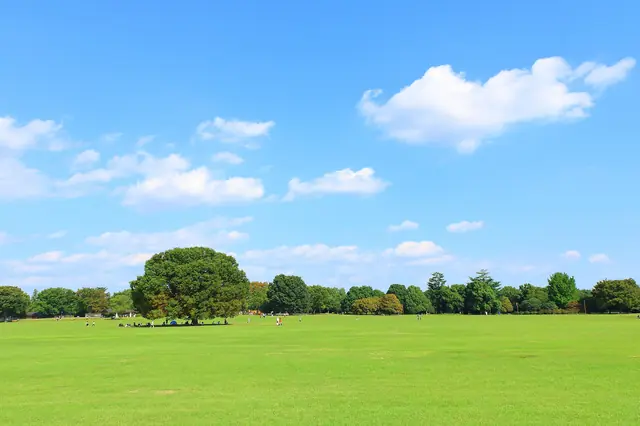
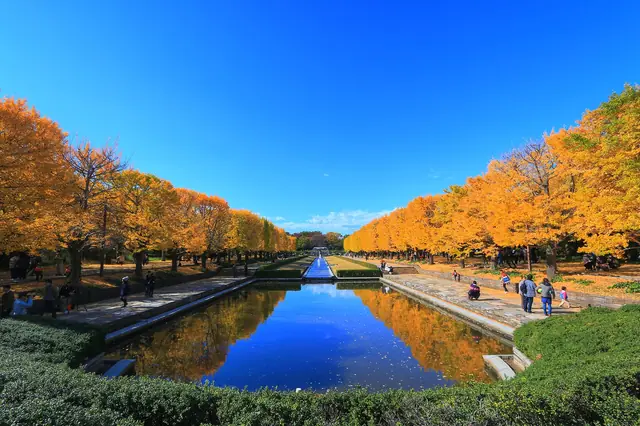
Think of it in zones. Around Akebono Gate, nearest Tachikawa Station, is a free area with the Showa Emperor Memorial Hall. Past Tachikawa Gate lies the Canal, a long formal water garden lined with ginkgo. In the middle is Minna no Harappa, an 11-hectare lawn with one huge zelkova, ringed by flower fields. The south has the Water Bird Pond with boats; the wooded north holds the Japanese garden, Children's Forest and Komorebi no Sato, a rebuilt farming hamlet. Crossing the park on foot takes about an hour, so pick your gate by what you want to see.
- Download the PDF maps from the official site or pick one up at the gate. In a park this size a map matters.
Spring and summer: rapeseed, tulips, poppies and sunflowers
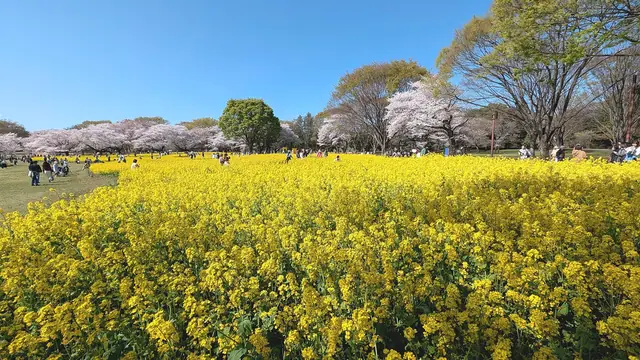
Plum blossom opens the year from mid-January to mid-March. Rapeseed fills the Harappa flower fields from late February to mid-April, and the park's 1,500 or so cherry trees, thickest in Sakura no Sono, flower from late March to mid-April, the busiest picnic weeks of the year.
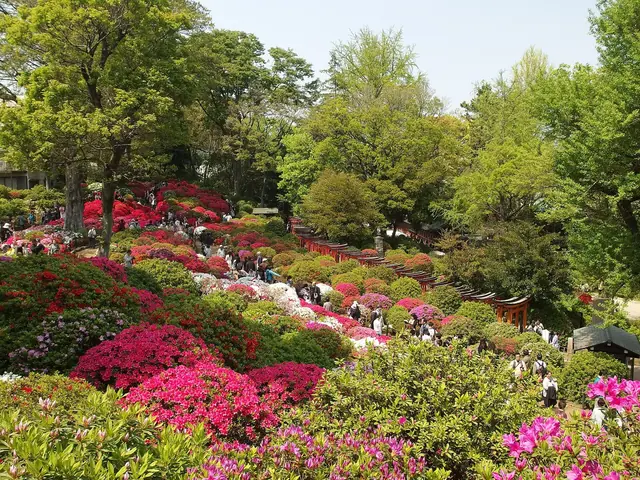
The spring Flower Festival runs from late March into late May. Its heart is the tulip garden along the stream in Keiryu Hiroba: about 250,000 bulbs of 260 varieties in 2026, best in early and mid-April. Nemophila covers a Harappa field from mid-April to mid-May, and in May the Hana no Oka hill turns red with poppies (Iceland poppies in earlier years, Shirley poppies with baby's breath in 2026). Wisteria and azaleas flower around the Canal and the Japanese garden from mid-April, irises from mid-May.
Summer is greener and quieter. Sunflowers bloom in a Harappa field from late July to mid-August, and the kochia on Herb Hill grows into green balls that turn red in October. On one evening in late July the Tachikawa festival fireworks rise over Minna no Harappa; since 2026 the central viewing area needs a paid ticket. The old Rainbow Pool has closed for good.
- Fields rotate from year to year. Check the bloom reports rather than last year's photos.
- On tulip and cherry weekends the car parks fill by mid morning. Come by train, at opening time.
Autumn and winter: cosmos, ginkgo and the night walk
The Cosmos Festival runs from mid-September to late October. In 2026 about four million yellow cosmos covered Hana no Oka until early October, followed by pink cosmos and red buckwheat in a Harappa field through October.
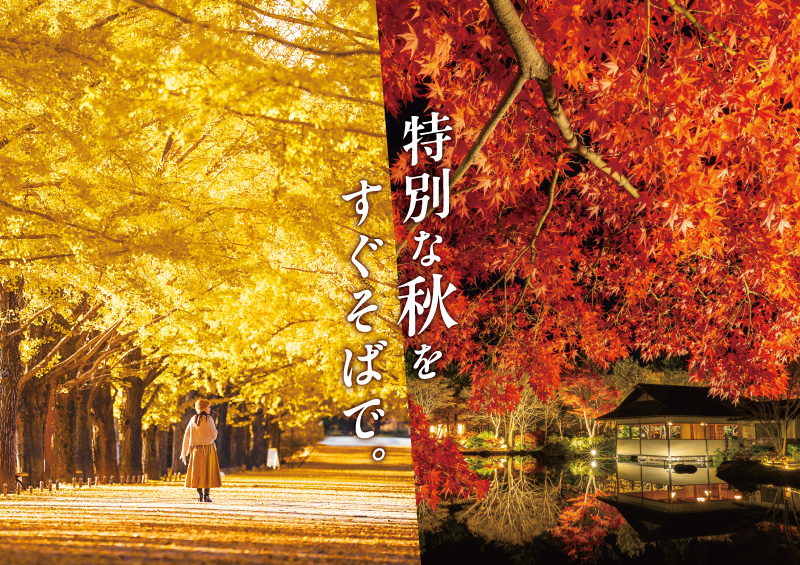
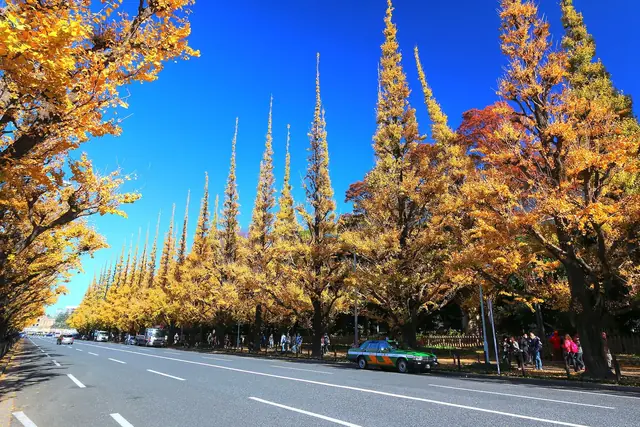
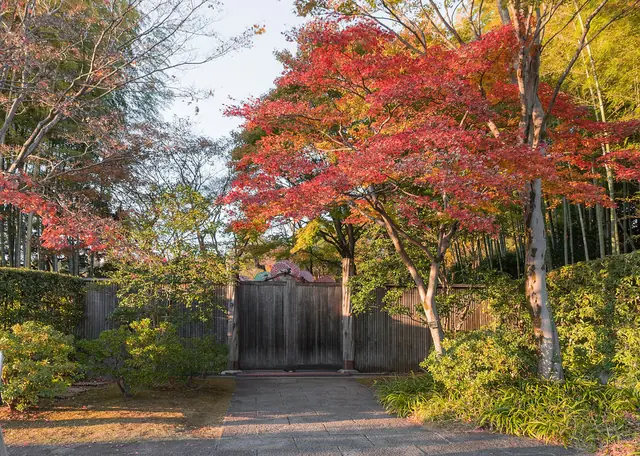
The Canal ginkgo avenue (about 200 m) and the Katarai ginkgo avenue (about 300 m) turn from late October and are usually best in mid-November. The Japanese garden maples peak in the second half of November. From late October to late November an autumn night walk lights the ginkgo avenues and the Canal, the park stays open until 9pm, and only Nishi-Tachikawa and Tachikawa gates are open after dark. The lit Japanese garden needs a separate night ticket, sold online from a week before.
There is no Christmas illumination now: the Winter Vista Illumination ended in 2018 and the autumn light-up replaced it. Winter brings wintersweet and early plum from mid-January and quiet walks on short days.
- For the ginkgo avenues without crowds, come on a weekday morning in mid-November.
The Japanese garden, bonsai and the old farm hamlet
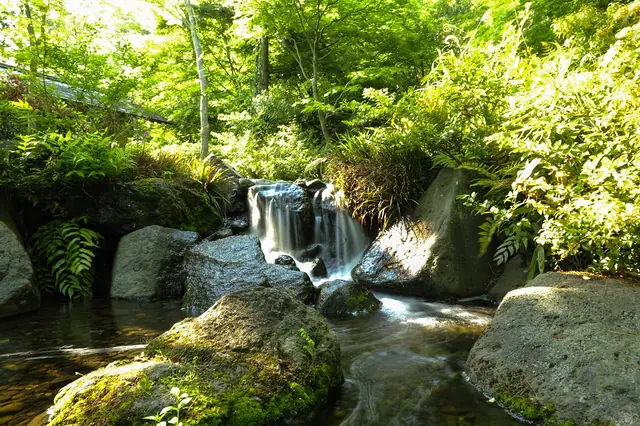
The Japanese garden, opened in 1997, is a 6-hectare strolling garden around a pond, with a 7 m waterfall. Kanfutei, a sukiya-style tea house, serves matcha with a sweet, and Seichiken, a rest house over the water, is the place to watch the carp. Rules are stricter here: no food or drink except water, no picnic sheets, no pets.
The bonsai garden inside the Japanese garden shows about 50 of its 80 trees at a time, led by a five-needle pine over 150 years old. A short walk north, Komorebi no Sato recreates a Musashino farming hamlet of the 1950s and 1960s, with a farmhouse, paddies and seasonal displays such as hina dolls before the Girls' Festival.
Cycling, children and barbecue
The 14 km cycling course is for bikes only. Rental centres at Tachikawa, Nishi-Tachikawa and Sunagawa gates have about 2,000 bikes, including child seats and tandems; as of 2026 an adult bike costs 600 yen for three hours. Return it where you rented it. Your own bike can come in through the bicycle entrances, but not electric mopeds or e-scooters, and walking on the course is forbidden.
Children head for the Children's Forest (Kodomo no Mori) in the north: the white Kumo no Umi domes to bounce on (junior high age and under), roller slides through the trees and a mist forest from March to November. It is about 25 minutes on foot from Nishi-Tachikawa Gate, closer from Sunagawa Gate. There are also boats on the Water Bird Pond and a park train that loops the grounds in about an hour, paid in cash.
Cooking is allowed only at the reserved barbecue spots: the BBQ Garden near Nishi-Tachikawa Gate, bookable from two months to four days ahead, and the barbecue at the Fureai Hiroba restaurant. Elsewhere fires and portable stoves are banned. Packed lunches on the lawns are fine, and small dome tents up to 2 m are allowed, but not tarps.
- Bring helmets for children: rental helmets are limited.
Gates, tickets, rules and getting there
Nishi-Tachikawa Gate is 2 minutes from JR Nishi-Tachikawa Station, one stop past Tachikawa on the Ome Line; some Chuo Line trains from Shinjuku run straight through. From the north exit of JR Tachikawa Station, Akebono Gate is 10 minutes on foot and Tachikawa Gate 18 minutes. Sunagawa Gate, best for the Japanese garden, is 13 minutes by Tachikawa Bus from the station's north exit.
As of 2026, entry is 450 yen for adults and 210 yen for 65 and over, free for junior high school students and younger. The park opens at 9:30am and closes at 5pm from March to October (6pm on weekends and holidays from April to September) and at 4:30pm from November to February. It is closed on December 31, January 1 and from the third Monday of January to the Friday of that week.
Drones and fireworks are banned and kites fly only on Minna no Harappa. Alcohol is not on the park's list of banned items. Dogs are welcome on a short lead after you fill in a pledge form at the gate, but not in the Japanese garden, on the cycling course or on the park train.
By Akebono Gate, GREEN SPRINGS has cafés, a concert hall and a hotel, handy for dinner after the night walk. From Nishi-Tachikawa the Ome Line continues into the mountains toward Okutama, and Mount Takao is about 25 minutes west of Tachikawa on the Chuo Line.
- Hours change around events. Trust the operating calendar on the official site.