Nemophila on Miharashi Hill
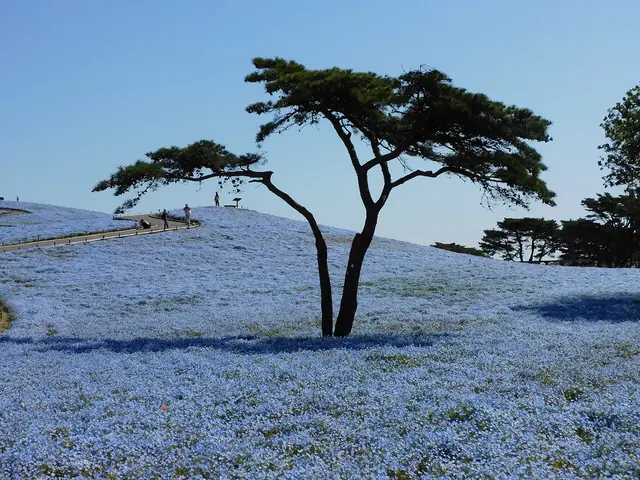
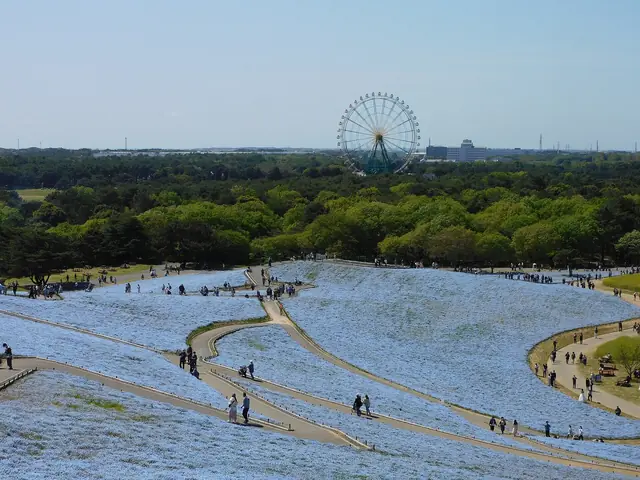
Miharashi Hill is the highest point of the park, a gentle dome you climb on a loop path. Every November the staff sow nemophila seed in rows 20 cm apart across the slopes, and by spring the whole hill is a single variety, Insignis Blue, about 5.3 million plants in 2026. On a clear day the blue of the flowers runs into the sky and the sea, and from the top you see the Pacific and the park's big Ferris wheel.
The park gives the season as mid-April to early May. In recent warm springs the peak has come early: in 2026 the hill was in full bloom around April 16, the main peak lasted to about April 26, and the late stage ran to May 1. That means the classic Golden Week visit can already be past its best. Watch the bloom reports on the official site and its social accounts, which post photos with dates, and go as soon as they say full bloom.
- The paths across the hill are roped off. Stepping into the beds for a photo is not allowed.
The year in the park, from daffodils to kochia
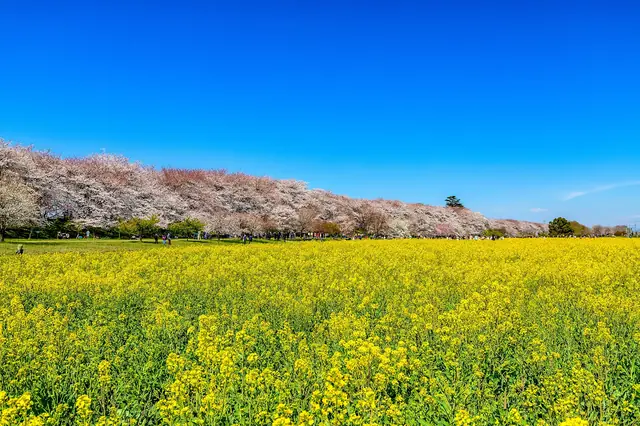
The year starts in March with daffodils, about a million of them under the pines of the Suisen Garden from late March to mid-April. From mid to late April about 280,000 tulips of some 320 varieties (2026 figures) fill the Tamago no Mori Flower Garden, and rapeseed turns Miharashi no Sato yellow at the foot of the hill. After the nemophila come poppies in May and about 3,400 roses in the Hitachi Rose Garden from mid-May to early June.
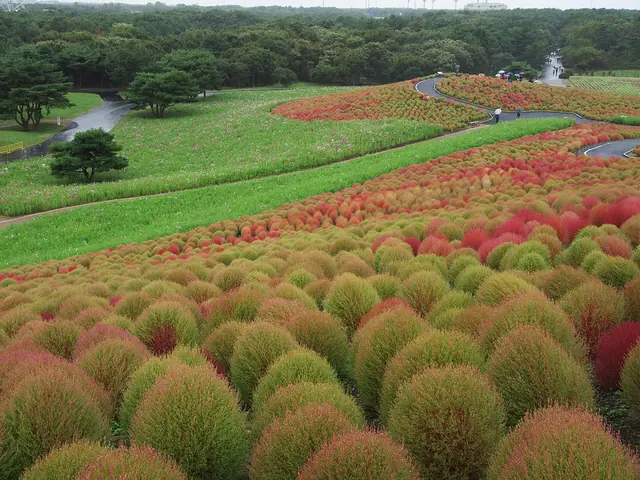
Zinnias bloom at Miharashi no Sato from late July into early August. The kochia, about 40,000 plants in 2026, go in as seedlings in June and grow into soft lime green balls: green from mid-August to late September, red in mid-October, then brown and gold into early November, when they are cleared for the next nemophila. Yellow cosmos grow between them, and a large cosmos field blooms in the Daisogen Flower Garden in October. Around New Year, ice tulips stand in the Glass House.
- Kochia red is short. If your goal is the red hill, aim for the middle of October and check the park's dated photo reports.
A park of 350 hectares: gates, the Seaside Train and bikes
The park is planned at 350 hectares, of which about 237 are open, so walking everything in a day is not realistic. There are four gates: the West Gate, which is the closest to Miharashi Hill and where the buses from Katsuta stop; the Central Gate and the South Gate; and the Kaihin Gate near the sea, the barbecue area and the shuttle from Ajigaura Station.
The Seaside Train is a road train that loops the park with nine stops. A day ticket is 600 yen as of 2026, free under three, paid in cash or with the amusement park's ride tickets, not by card. In spring and autumn it also runs direct trips to Miharashi Hill. Pets are not allowed on it.
Cycling is the best way to see it all: the course is about 13 km, and four cycle centres hold around 1,400 rental bikes. As of 2026 an adult bike is 600 yen for three hours and an electric assisted one 900 yen. You may ride only on the cycling course, rentals stop an hour before closing, and the South centre opens on weekends and holidays only.
- Electric bikes are limited and go first on busy days. Rent one early if the hills worry you.
Getting there from Tokyo
The usual way is the JR Joban Line limited express from Shinagawa, Tokyo or Ueno to Katsuta, about 85 minutes from Tokyo Station. Tokiwa trains stop at Katsuta, but not every Hitachi train does, so check before you board. Seats on these trains are reserved, and a seat-unspecified ticket lets you ride any train but may mean standing. The Japan Rail Pass covers the trip.
From the East Exit of Katsuta Station, Ibaraki Kotsu buses from stop 2 reach the West Gate in about 15 minutes, with extra direct buses in the nemophila season. Or take the small Minato Line of the Hitachinaka Seaside Railway to Ajigaura, about 30 minutes, then a short bus ride to the West Gate or a 20 minute walk to the South Gate; in spring 2026 a free shuttle also ran from Ajigaura to the Kaihin Gate on weekends and holidays.
By highway bus, the Mito-go runs from the Yaesu South Exit of Tokyo Station to Mito in about two hours; from there it is six minutes by JR to Katsuta. Driving is the slowest choice in spring, when the Joban and Kita-Kanto expressways jam badly on weekends. See the official access page.
- Hitachi Seaside Park is in Hitachinaka, not in the city of Hitachi further up the coast. Do not get off at Hitachi Station.
Golden Week crowds, fees and rules
Over the ten days of Golden Week the park has counted around 300,000 visitors in recent years, and late morning to early afternoon is the worst. Go on a weekday in mid to late April, which also suits the recent early peaks; use the early openings (in 2026, 7am instead of 9:30am on April 29 and May 3 to 5); and climb Miharashi Hill first, leaving the gardens for later.
As of 2026, admission is 450 yen for adults, 210 yen for 65 and over, and free for junior high students and younger. In the spring season (April 3 to May 6 in 2026) and the autumn kochia season (October 9 to November 3) a 350 yen seasonal fee is added, so adults pay 800 yen. There is no reservation or timed entry: you pay at the gate, where machines take cards and transit IC cards. Parking is 600 yen a car.
The park is open 9:30am to 5pm most of the year (to 6pm in summer, to 4:30pm from November to February) and closes on Tuesdays outside its busy seasons. Dogs are allowed on a lead of 2 m or less, with a rabies shot in the last year and a pledge signed at the gate, but not on the train or the cycling course. Drones and fires are banned, tents can be at most 2 m square, and the flower beds are off limits.
- The car parks and the roads in fill first. On peak days the train and bus are often faster than driving, even with the change at Katsuta.
Nakaminato fish market, the coast and summer music
About 15 minutes by car from the park, near Nakaminato Station on the Minato Line, the Nakaminato Fish Market lines the fishing port with eight restaurants and five fish shops. A bowl of raw fish on rice here is the classic pairing with the park. On spring and autumn weekends it is packed, so the train is easier than the car.
Nearby, Sakatsura Isosaki Shrine has a 300 m approach under a tunnel of old trees, and the Oarai aquarium, known for its sharks, is about 25 minutes by car.
For twenty years the park hosted Rock in Japan, one of the country's biggest music festivals. The last edition here was in 2019; since 2022 it has been held at Soga Sports Park in Chiba City, in September from 2025. The park now hosts LuckyFes, run by the Ibaraki radio station LuckyFM, over four days in August in 2026, when parts of the park are closed.
- A simple plan: Miharashi Hill at opening, the gardens by bike, then the Minato Line to Nakaminato for a late lunch and back to Katsuta.