Which garden for which day
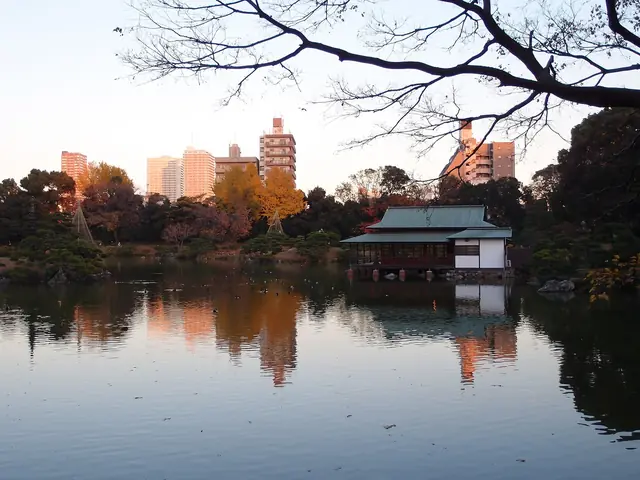
For roses and a full day out: Jindai Botanical Garden in Chofu. For history and huge old trees in the middle of the city: the University of Tokyo's Koishikawa Botanical Garden in Bunkyo. For tropical plants under tall glass domes, close to central Tokyo: Yumenoshima in Koto. For a greenhouse after a walk on the lawns: Shinjuku Gyoen. For something free and unusual: the Medicinal Plant Garden in Kodaira. For cherries from February into May: Tama Forest Science Garden near Takao. For a small Edo-period flower garden: Mukojima-Hyakkaen.
On rainy days the greenhouses are the point: warm and humid all year, with many tropical plants flowering in winter and fewer people when it rains. Where an outdoor garden and a greenhouse share one ticket, as at Jindai, Koishikawa and Shinjuku Gyoen, you can wait out a shower under glass. In winter the outdoor gardens still have plum, camellias, wintersweet and early cherries from January to March.
Two practical points apply almost everywhere. Most gardens close on Mondays, or on Tuesday after a Monday holiday, and greenhouses close earlier than the gardens around them, some as early as 3pm. Mukojima-Hyakkaen is the exception: it opens every day except over the New Year.
- Jindai, Yumenoshima and Mukojima-Hyakkaen are free for everyone on Greenery Day (May 4) and Tokyo Citizens' Day (October 1), and busier for it. Koishikawa is free on May 4 only.
Jindai Botanical Garden, Chofu
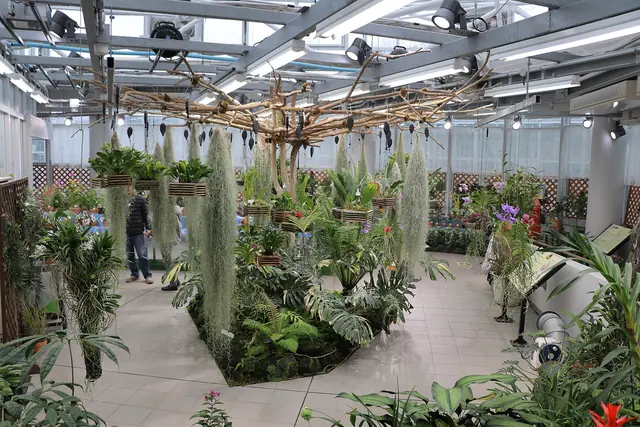
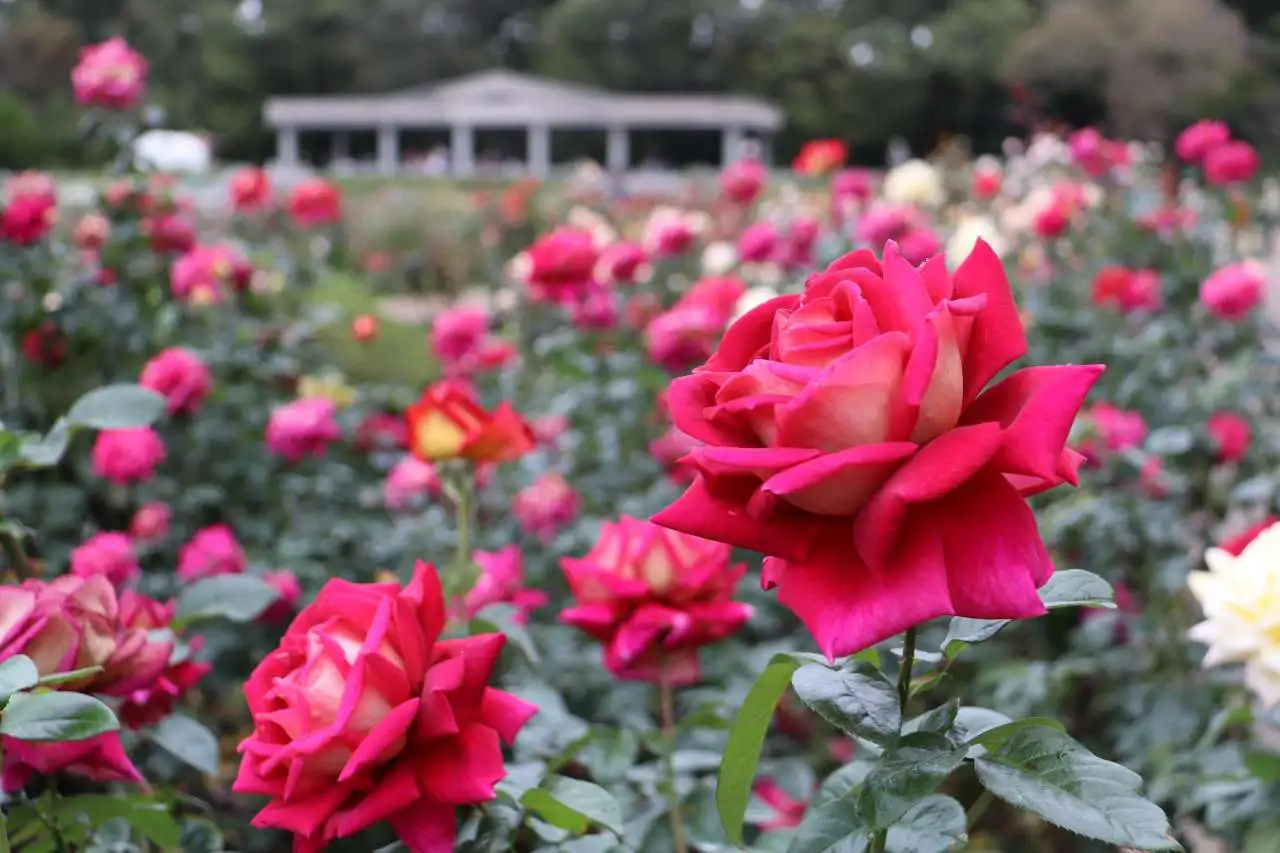
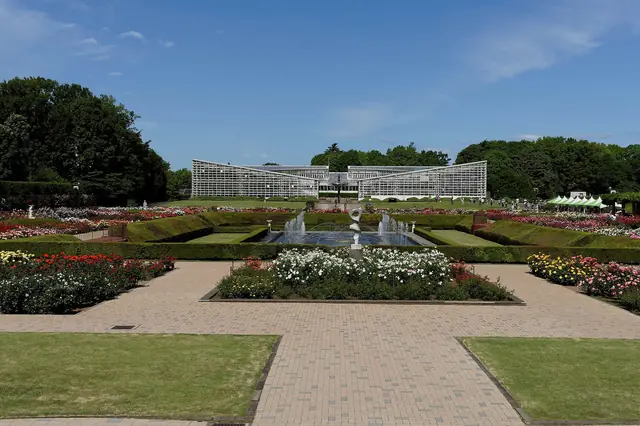
Jindai Botanical Garden is the largest and most complete: about 4,800 kinds of plants on 52 hectares of plateau and woodland. It suits a full day and anyone who loves roses. Its sunken rose garden, about 400 varieties around a fountain, peaks in mid to late May and again from mid-October, with a festival each time. The greenhouse holds about 1,300 species, including tropical water lilies, begonias and orchids, and the free aquatic plants garden next to Jindaiji has irises in June. It is in western Tokyo, reached by bus from Chofu, Kichijoji or Mitaka, and soba at the temple next door makes a good lunch. As of 2026 adults pay 500 yen.
Koishikawa Botanical Garden, Bunkyo
The Koishikawa Botanical Garden, officially the Botanical Gardens of the University of Tokyo's Graduate School of Science, is the oldest botanical garden in Japan. It began in 1684 as a herb garden of the Tokugawa shogunate and became part of the university in 1877. It is a research garden first, about 16 hectares of plateau, slope and ponds, and that shows: plants carry labels, there are no lawns for games and the mood is calm.
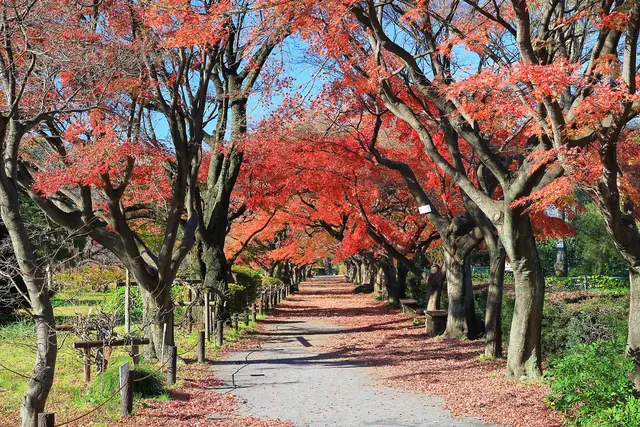
Look for the descendants of Newton's apple tree and Mendel's grapevine, the ginkgo in which Hirase Sakugoro discovered ginkgo sperm cells in 1896, and the well of an Edo-period clinic for the poor. Plum flowers near the Japanese garden in February, Somei Yoshino in late March, and the maple avenue turns red in late November and early December. The greenhouse, rebuilt in 2019, shows about 2,000 species in six rooms, with a cooled room for alpine plants beside it.
As of 2026 no reservation is needed: buy a ticket at the machine to the left of the main gate (500 yen for adults, 150 yen for children), and note there is no re-entry. The garden opens 9am to 4:30pm (last entry 4pm), the greenhouse only 10am to 3pm, and it closes on Mondays and from December 29 to January 3. Eating is allowed; alcohol, smoking, pets and drones are not. The main gate is about 10 minutes on foot from Exit A1 of Hakusan Station (Toei Mita Line).
- Do not confuse it with Koishikawa Korakuen, the feudal lord's garden by Tokyo Dome. In map apps, search for the main gate ticket office, as the garden itself advises.
Greenhouses for rainy and cold days
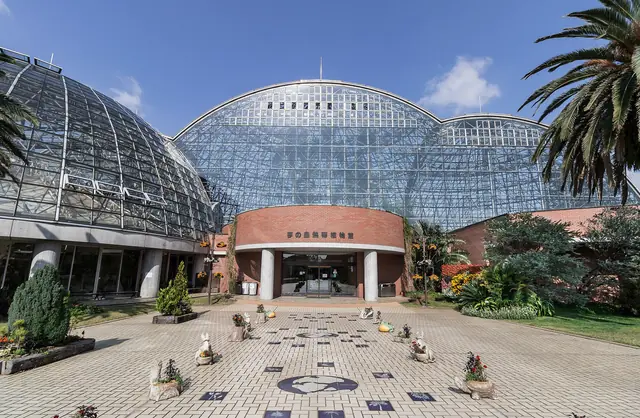
The Yumenoshima Tropical Greenhouse Dome in Koto is the easiest greenhouse to reach from central Tokyo, about 15 minutes on foot from Shin-Kiba Station (JR Keiyo Line, Yurakucho Line, Rinkai Line). Three connected glass domes hold around 1,000 species: dome A recreates a tropical waterside, dome B grows plants people use, such as cacao and bananas, and dome C is planted with plants of the Ogasawara Islands. The heating comes from waste heat of the neighbouring incineration plant. As of 2026 adults pay 250 yen; it opens 9:30am to 5pm (last entry 4pm) and closes on Mondays and from December 29 to January 3.
Next door, the free Daigo Fukuryu Maru Exhibition Hall keeps the tuna boat exposed to fallout from the 1954 hydrogen bomb test at Bikini Atoll; with the dome it makes an indoor half day by the bay.
The greenhouse at Shinjuku Gyoen is included in the garden ticket (500 yen for adults as of 2026) and holds over 1,000 species, including endangered plants from Okinawa and the Ogasawara Islands. It opens later and closes earlier than the garden. Of all the greenhouses here, Koishikawa's, open only from 10am to 3pm, is the one to plan around.
West Tokyo: a free herb garden and a cherry forest
The Tokyo Metropolitan Medicinal Plant Garden in Kodaira is run by the city's public health institute, which uses it to identify illegal drug plants, and entry is free. About 2 minutes from Higashi-Yamatoshi Station on the Seibu Haijima Line, it has areas for kampo and folk medicine plants, dye plants, a greenhouse, and poisonous plants with notes on which wild greens are easily mistaken for edible ones. The opium poppies in a fenced test plot flower in early May and are its best-known sight.
As of 2026 it opens 9am to 4:30pm from April to September and to 4pm in winter, and closes on Mondays, except some Mondays in April and all in May, and over the New Year. Eat only at the arbours and benches; smoking, alcohol and fire are banned, and pets may come only as far as the car park.
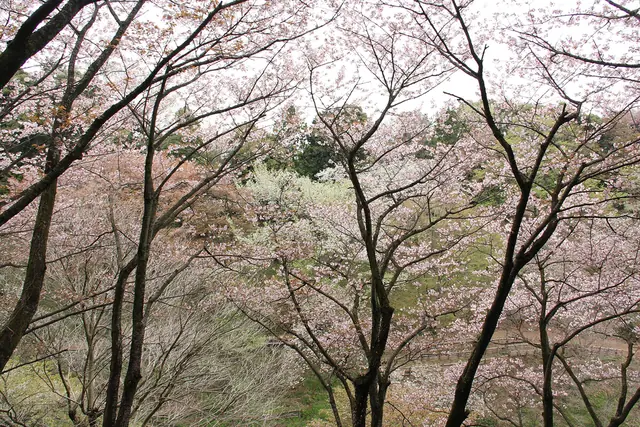
Tama Forest Science Garden, about 10 minutes on foot from the north exit of Takao Station, belongs to a national forestry research institute. Its cherry preservation forest keeps clones of famous cherry trees from all over Japan, well over a thousand trees on about 8 hectares of hillside, so something flowers from February into early May, most of all in April. Since March 2025 the cherry forest has been partly open again after a closure. Paths are steep in places, so wear walking shoes.
As of 2026 adults pay 200 yen, or 300 yen in April. It opens at 9:30am (9am in April) and closes at 4pm, with last entry at 3:30pm, and is closed on Mondays and over the New Year. It is a research site with no alcohol, no pets and no food for sale. Combine it with Mount Takao on the same day.
Mukojima-Hyakkaen and, further out, Ofuna
Mukojima-Hyakkaen is a flower garden rather than a botanical garden. An antiques dealer, Sahara Kikuu, opened it in the early 1800s with the writers and painters of Edo and filled it with the plants of Japanese and Chinese poetry. It is small and informal, best in February for plum, in September for its bush clover tunnel and in November for chrysanthemums. As of 2026 adults pay 150 yen. It is open every day except December 29 to January 3, which makes it the garden for a Monday, and it is about 8 minutes on foot from Higashi-Mukojima Station on the Tobu Skytree Line.
In Kanagawa, the Ofuna Flower Center, the prefectural botanical garden now known as Hibiya Kadan Ofuna Flower Center, is about 15 minutes on foot from the west exit of JR Ofuna Station, two stops from Kamakura. It is known for Ofuna peonies, herbaceous peonies bred here for export since the Meiji era, about 210 varieties that flower in early to mid-May, and for irises in June and lotus in summer. Tamanawa-zakura, an early cherry selected here, opens in late February. It closes on the second and fourth Mondays, and adults paid 400 yen in 2026.