From a street-tree nursery to a botanical garden
The garden began as a nursery where the city grew trees for Tokyo's streets. After the war it opened as a green space, and in 1961 it became a botanical park under its present name. Today it covers about 52 hectares, with roughly 4,800 species and varieties arranged in about thirty blocks by plant group, plus patches of old Musashino woodland.
One cherry from here has spread across Japan. Jindai Akebono, with slightly smaller and pinker flowers than Somei Yoshino, was found at this garden and registered in 1991. It resists the witches' broom disease that weakens Somei Yoshino, so many towns now plant it instead.
The main gate is on the north side by the bus stop, the rose garden and the greenhouse are in the middle, and the Jindaiji gate on the south side leads down through woodland to the temple. On scheduled days free volunteer guides start from the information building near the main gate and show what is in flower that week.
The rose garden and the two rose festivals
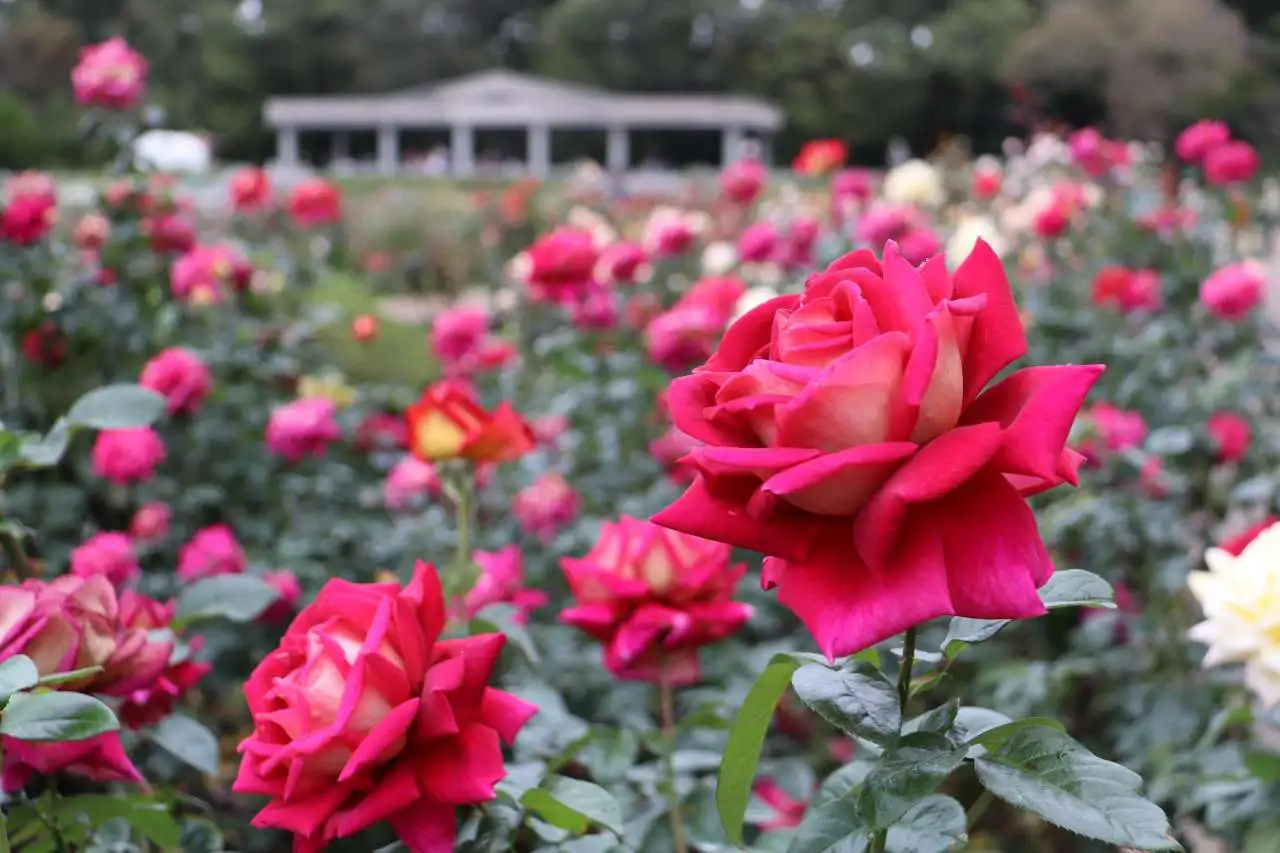
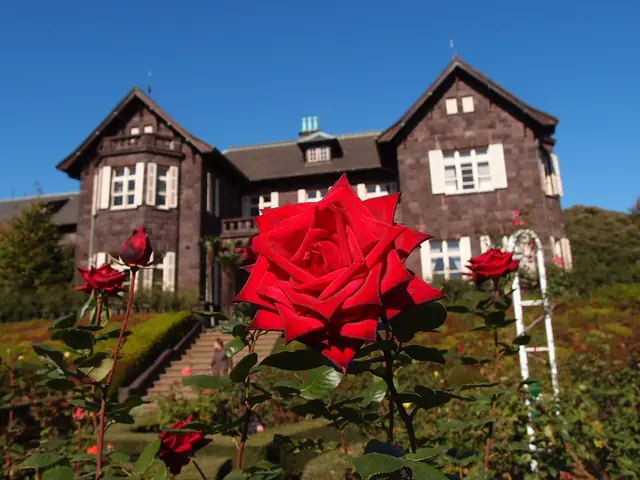
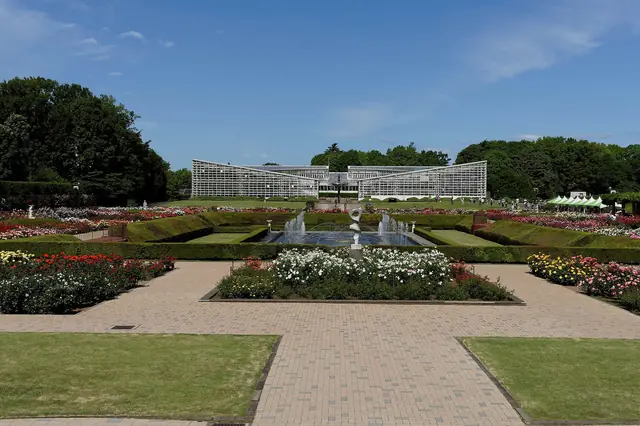
The heart of the place is the rose garden, a sunken formal garden laid out symmetrically around a fountain, with the glass greenhouse behind it and a pillared rest house on the terrace above. About 400 varieties and 5,200 plants grow here. It has received the Award of Garden Excellence of the World Federation of Rose Societies and grows all 19 roses in the federation's hall of fame, Peace among them, as well as Queen of Jindai, a rose named after the garden.
Spring roses peak from about mid-May into late May, and the spring rose festival fills most of the month. Autumn roses open from about mid-October and last into November, with fewer flowers but deeper colours and a stronger scent, and the autumn festival runs into late November. Festival days bring small concerts, a rose café terrace and rose shows, and in 2026 the garden opened early, at 8am, on festival weekends in both spring and autumn.
Weekend afternoons in mid-May are the busiest time of the year, with queues at the bus stops and full car parks. A weekday morning, or the first hour of an early opening, gives you the scent without the crowd.
- The garden still closes on Mondays during the rose festivals.
- The classic view of the whole rose garden, with the fountain and the greenhouse behind, is from the terrace by the rest house.
The flower year, garden by garden
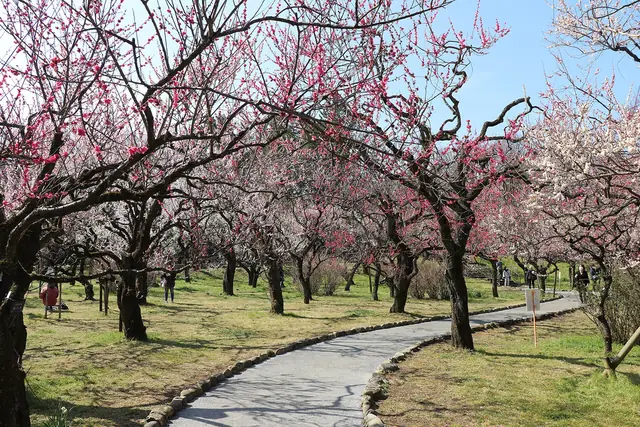
The year starts in the plum garden, about 160 trees of some 70 varieties that flower from early February into early March, with camellias and wintersweet nearby. About 600 cherry trees follow, with Somei Yoshino and Jindai Akebono in late March and early April and double-flowered varieties into mid-April.
Mid to late April belongs to the azalea garden, 12,000 plants of about 280 varieties, and to the rhododendrons beside it. Tree peonies open in the peony garden around the second half of April and herbaceous peonies (shakuyaku) follow in May, overlapping with the spring roses. The bush clover garden flowers in September.
Autumn is the second high season: roses again from mid-October, a chrysanthemum show in the first half of November with classic forms trained over many months, tall pampas grass, and the maple garden, which colours from late November into early December. On winter weekdays the garden is very quiet, and the greenhouse is the warmest place to be.
- The garden posts what is in bloom each week on its official site and on X.
The greenhouse and the aquatic plants garden
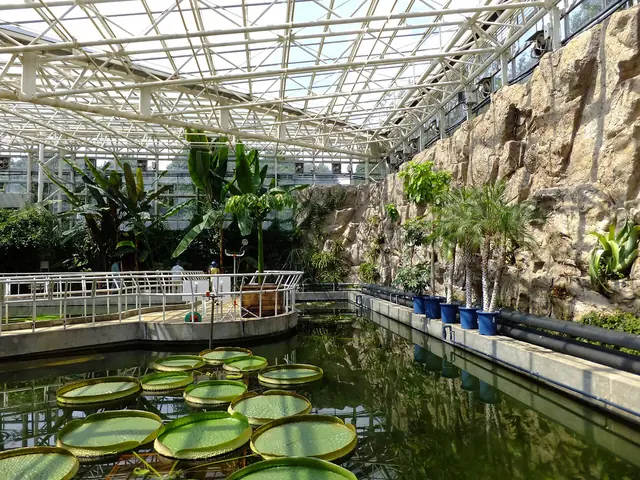
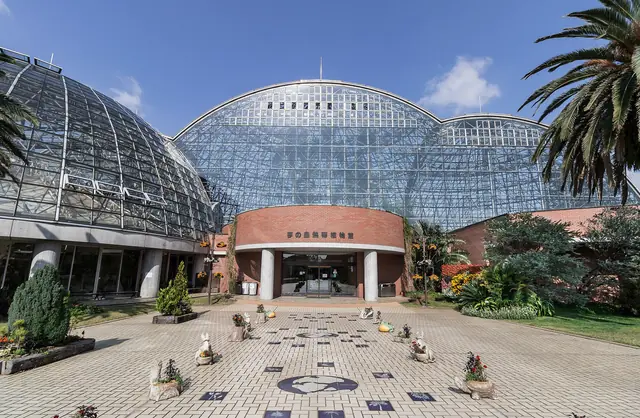
The large greenhouse behind the rose garden was renovated in 2016 and holds about 1,300 species: tropical flowering trees, a pool of tropical water lilies with giant Victoria pads, rooms for begonias and orchids, plants of the Ogasawara Islands, cacti and carnivorous plants. It is the place to go on a rainy or cold day, and it closes at 4:30pm, earlier than the garden.
The aquatic plants garden is a separate section next to Jindaiji, across the road from the main garden. Spring water from the hill behind the temple gathers there in a wetland crossed by boardwalks, with irises in June and water lilies in summer. Entry is free and it also closes at 4:30pm. The hill above holds the earthworks of Jindaiji Castle, a medieval fort that is a national historic site.
- The aquatic plants garden and the Plant Diversity Center, which shows wild plants of Musashino and the Izu Islands, are both free.
- Pets are not allowed in the paid garden, the aquatic plants garden or the Plant Diversity Center.
Jindaiji, soba and the daruma fair
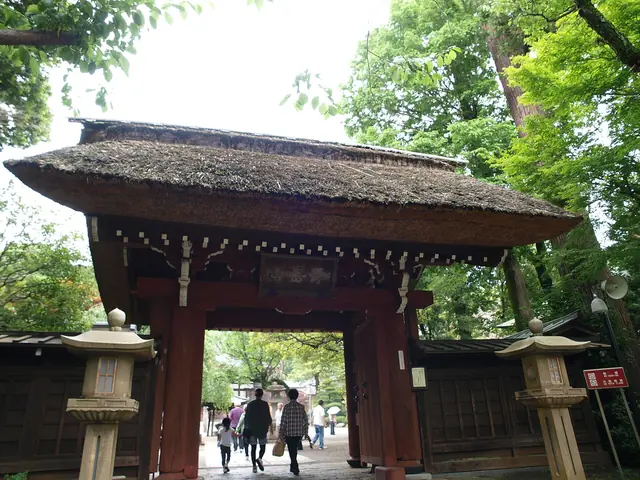
Jindaiji is a Tendai temple founded, by its own account, in 733, the second oldest temple in Tokyo after Sensoji. Its thatched gate and wooded grounds sit in a hollow full of springs. The Shakado hall shows a gilt bronze seated Buddha from the late 7th century, found under the floor of a hall in 1909, a National Treasure and the oldest of its kind in eastern Japan.
The spring water is also why the area is known for soba. A couple of dozen soba shops, many with gardens or open terraces, line the lanes around the temple. Lunch hours on fine weekends mean queues, so eat early or late.
On March 3 and 4 every year the temple holds the Yakuyoke Ganzan Daishi festival with a daruma market, counted among the three largest in Japan, with around 300 stalls. After you buy a daruma, monks paint the Sanskrit letter 'a', the sound of beginnings, into its left eye. When the wish comes true, you bring it back to have 'un', the sound of endings, written in the right eye and leave it at the temple.
- On daruma fair days the street to the temple is one way for cars and parking is hard, so come by bus.
Getting there, tickets and rules
No train line reaches the garden, so the last stretch is by bus. From Chofu Station on the Keio Line, Odakyu buses for Kichijoji or Mitaka (stop 12) reach Jindai Shokubutsu Koen-mae by the main gate in about 15 to 20 minutes, and Keio buses for Jindaiji (stop 11) also stop at the garden. From Tsutsujigaoka Station, Keio buses for Jindaiji leave from the north exit. From Kichijoji Station (stops 4 or 6) and Mitaka Station (stops 2 or 3) on the JR Chuo Line, Odakyu buses for Chofu Station North Exit or Jindaiji take about 25 to 30 minutes.
A good loop is to ride to the main gate, leave by the Jindaiji gate, walk down to the temple for soba and catch a bus back from the Jindaiji stop. Allow two to three hours for the garden and half a day with the temple.
As of 2026 the garden opens from 9:30am to 5pm (last entry 4pm) and closes on Mondays (the next day when Monday is a holiday) and from December 29 to January 1. Adults pay 500 yen, those 65 and over 250 yen and junior high school students 200 yen (free if they live or study in Tokyo). Primary school children and younger enter free, and everyone enters free on May 4 and October 1. Machines take cash, cards and QR payments, and the counter also takes transit IC cards. Festival dates are on the official page.
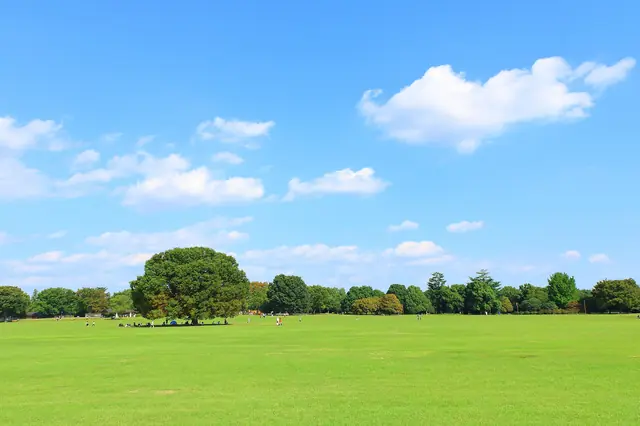
Pets stay outside (there is a dog run beyond the gates), picking plants and stepping into the beds are not allowed, and drones are banned in metropolitan parks. Packed lunches are fine on the big lawn plaza, which has a café beside it.