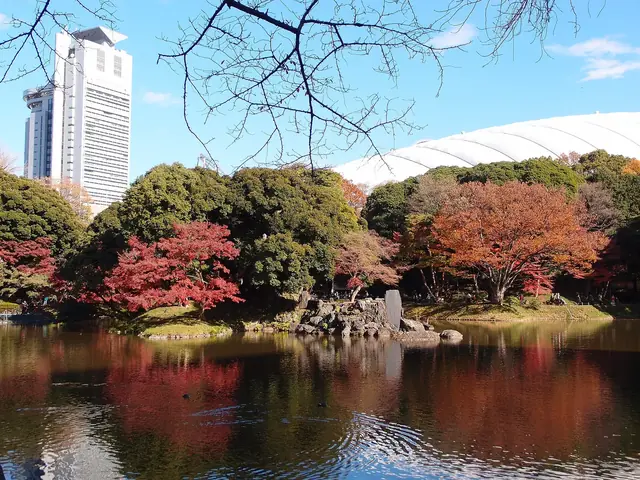
A garden of the Mito Tokugawa
Tokugawa Yorifusa, first lord of the Mito domain, began the garden at his Edo residence in 1629, and his son Mitsukuni finished it. Mitsukuni took advice from the Ming Chinese scholar Zhu Shunshui and named it Korakuen after a Chinese saying: a good ruler worries before the people worry and enjoys himself only after they do. The name later passed to the whole district, which is why the stadium next door was once called Korakuen Stadium.
The garden shrinks famous Japanese and Chinese landscapes into one walk: a sea, rivers, a mountain path and even a small rice field. It opened to the public in 1938 and, with Hama-rikyu, is one of only two Tokyo metropolitan gardens designated both a Special Historic Site and a Special Place of Scenic Beauty.
What to see
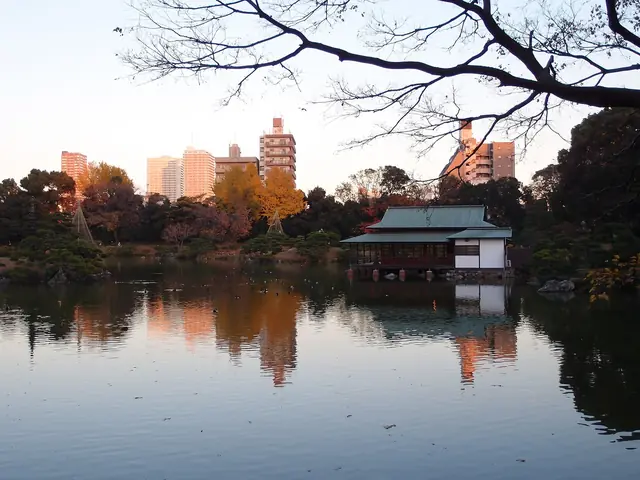
Most visitors come in by the West Gate near Iidabashi. The Karamon, the garden's formal gate, was restored and finished at the end of 2020. Past it opens the Oizumi, a large pond standing in for the sea, with Horaijima, a turtle-shaped island with a small Benzaiten shrine that you see from the shore.
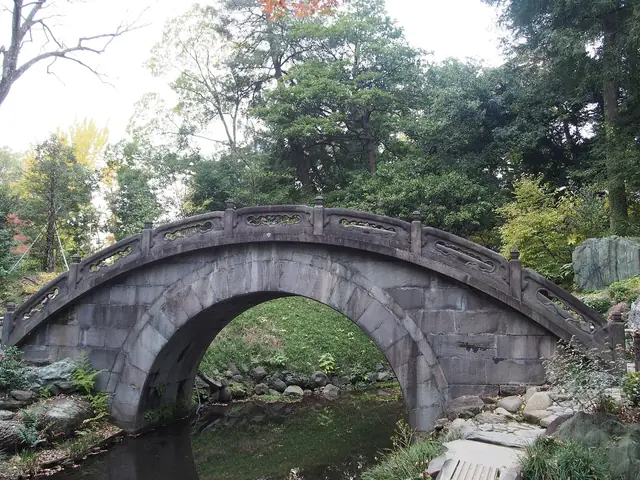
Along the water runs the Seiko embankment, a stone causeway modelled on the West Lake in Hangzhou, and a stream valley leads to Tsutenkyo, a red-lacquered bridge set among maples. Further in is Engetsukyo, a stone arch attributed to Zhu Shunshui and one of the oldest of its kind in Japan; its half circle and its reflection make a full moon, which gives it its name. Tokujindo, a small hall on the hillside, is the only building left from the garden's first construction.
Near the West Gate, Kantokutei has a tea room serving matcha and sweets, and a lunch spot; days and hours vary.
- Paths include stone steps and uneven ground. Wear flat shoes, especially after rain.
The year at Korakuen
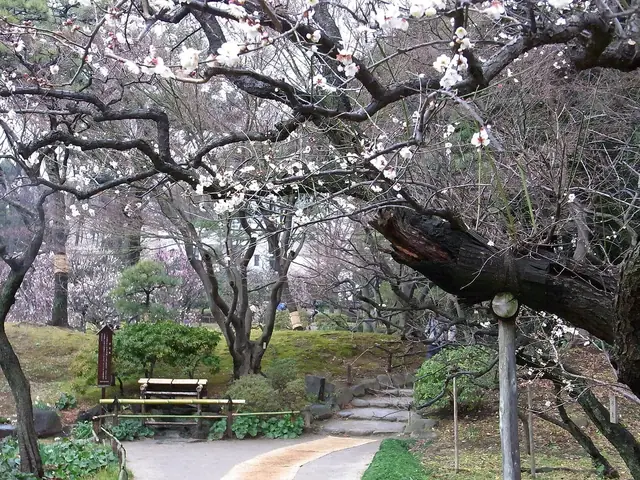
The garden is planted for every season. The plum grove, with red and white varieties, flowers from early February into March. In late March the weeping cherry near the West Gate is the spring highlight, followed by wisteria. In June about 660 Japanese irises fill the iris field, with hydrangeas nearby, and lotus flowers appear on the ponds in summer.
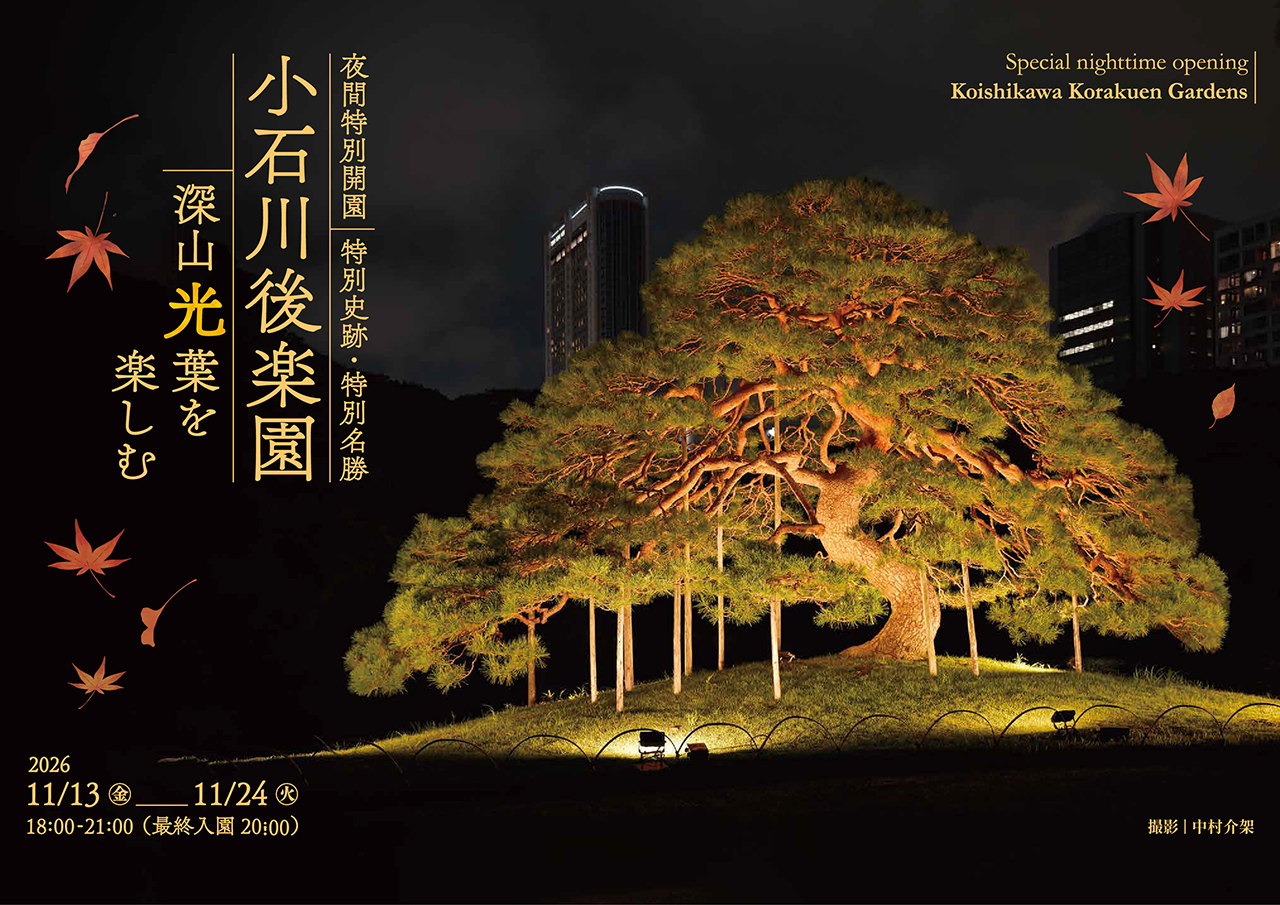
Red spider lilies come in September. Autumn colour starts around mid-November and is usually at its best in late November, when the maples around Tsutenkyo turn deep red. In recent years the garden has held a ticketed night light-up in the autumn colour season. Winter brings camellias and wintersweet.
Some fixed days are worth knowing: admission is free on Greenery Day (May 4) and Tokyo Citizens' Day (October 1), and in recent years the Karamon and Tokujindo have been opened for a closer look on Culture Day (November 3). In autumn a stamp rally links the nine metropolitan gardens.
Timing, tickets and tours
The garden is open every day from 9 in the morning to 5 in the afternoon (last entry half an hour before), closing only over the New Year. There is a small entrance fee; children of primary school age and younger enter free. Cards, transit IC cards and most QR payment apps are accepted at the gate, and same-day e-tickets can be bought online. Night light-ups need their own ticket.
Free guided walks run most of the year: in Japanese on weekends, Mondays and holidays, and in English on Saturdays, with none in July and August. If you plan to visit Rikugien, Hama-rikyu or Kiyosumi Teien as well, an annual pass covering all nine metropolitan gardens is sold at the gate.
Weekday mornings are the quietest. Weekends at peak bloom and autumn colour fill up by midday, and on Tokyo Dome game or concert days the stations around the garden are crowded even if the garden itself is calm. It is a quiet place, so keep to the paths and keep voices low.
- Weather can cancel guided walks. If you want the English tour, aim for a Saturday with a dry forecast.
Getting there and nearby
The West Gate is about 3 minutes from Exit C3 of Iidabashi Station on the Oedo Line and about 8 minutes from the JR, Tozai, Yurakucho and Namboku platforms at Iidabashi. The East Gate is about 5 minutes from the West Exit of JR Suidobashi Station, about 6 minutes from Korakuen Station (Marunouchi and Namboku lines) and about 8 minutes from Suidobashi on the Toei Mita Line. There is no parking.
Next door is Tokyo Dome City, with Tokyo Dome for baseball and concerts and Korakuen Hall for boxing and wrestling. From Iidabashi, Kagurazaka is a pleasant street for dinner. Rikugien, the other great daimyo garden in Bunkyo, is a short ride north, and Akihabara and Kanda Myojin are a few stops east.