Getting there and which ticket to buy
From Shinjuku, the Odakyu line runs to Katase-Enoshima, the end of the line, in a little over an hour, usually with a change at Fujisawa. Some Romancecar limited express trains run straight through in about an hour, mostly at weekends and on holidays, with a reserved seat on a separate ticket. Katase-Enoshima, whose station building is styled after Ryugu-jo, the sea god's palace of Japanese folk tales, is the closest station to the bridge.
From Tokyo Station or Shinagawa, take the JR Tokaido Line to Fujisawa and change to the Enoden, or ride JR to Ofuna and switch to the Shonan Monorail, a suspended train that swings over the hills to Shonan-Enoshima in about 15 minutes. That station and Enoden Enoshima Station stand close together, a few minutes further from the bridge than Katase-Enoshima.
If you start on the Odakyu line, Odakyu's Enoshima-Kamakura Freepass bundles a discounted round trip with a day of unlimited rides on the Odakyu line between Fujisawa and Katase-Enoshima and on the whole Enoden, plus small discounts at sights. It does not cover JR, the monorail or the Romancecar seat charge. If you only need the Enoden, its own one-day pass, Noriorikun, is the simpler buy.
- Suica and PASMO work on every line here, the Enoden and the monorail included, so you never need a paper ticket.
- The freepass is sold at Odakyu stations and as a phone ticket. Activate the digital version before your first ride.
The island on foot, from the bridge to the caves
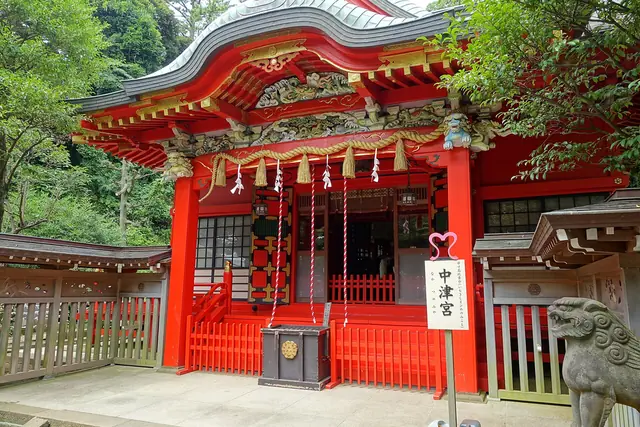
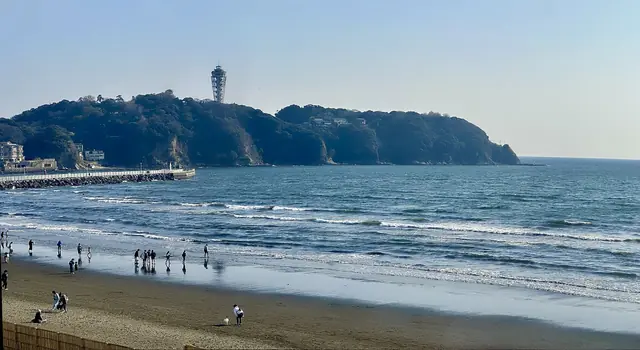
Enoshima is about 4 km around and rises to some 60 m, and the classic route crosses it end to end. After the long Benten Bridge comes a bronze torii, rebuilt in 1821, and then Benzaiten Nakamise, a steep lane of old inns, seafood restaurants and snack stalls that has welcomed pilgrims since the Edo period. At its top stands Hetsunomiya, the first of the three shrines of Enoshima Shrine, said to have been founded in 1206 by the shogun Minamoto no Sanetomo. Beside it, the octagonal Hoanden hall shows two Kamakura-period statues of Benzaiten, one of them the nude goddess holding a biwa lute, for a small fee.
Higher up, the vermilion Nakatsunomiya is lined with stone lanterns given by Edo-period merchants and performers. If you would rather skip the steps, the Escar, opened in 1959 as Japan's first outdoor escalators, carries you up in three stages. At the summit, the Samuel Cocking Garden grew from a garden that a British trader began laying out in 1882, and it is free in the daytime on days without events. Inside it stands the Sea Candle, a lookout lighthouse about 60 m tall with a glass-walled deck and an open-air deck above it.
From the top, the path drops down the far side past the Bell of Dragon Love, hung with couples' padlocks, and Okutsunomiya, whose ceiling turtle seems to stare at you from every angle, to Chigogafuchi, a wave-cut rock shelf facing the open sea. Steps lead on to the Iwaya caves, two sea caves where Kobo Daishi and Nichiren are said to have trained. The first runs 152 m into the cliff and you walk part of it by candlelight. On calm days a small boat, the Benten-maru, has long run from near the caves back to the bridge, which saves the climb, with fewer sailings in winter.
- The Escar only goes up. Coming back, you walk down the steps, which is much easier than the climb.
- The tower, the escalators and the caves each have their own ticket. The garden around the tower is free on most days.
- In 2026 the Sunset Terrace beside the Sea Candle is closed for rebuilding, planned until about the end of November.
- Keep back from the edge at Chigogafuchi when the waves are high. The caves close in storms.
Fuji, sunsets and the year on Enoshima
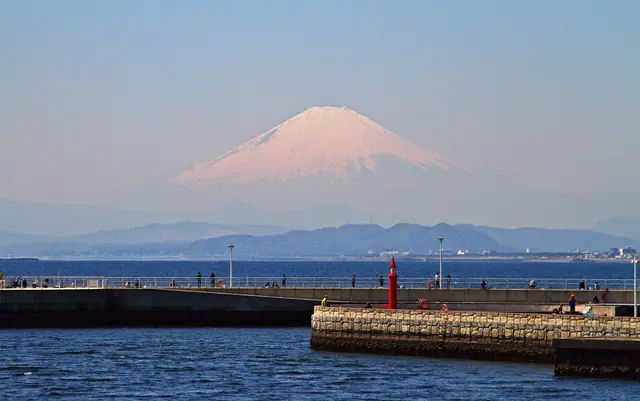
Mount Fuji rises beyond the bay to the west, and you see it best on clear, dry days from late autumn to early spring, early in the morning or at sunset. The open-air deck of the Sea Candle, the rocks at Chigogafuchi and the bridge itself are the classic spots, and on the clearest days the tower looks as far as the Izu Peninsula and even Tokyo Skytree. In summer, haze often hides Fuji completely.
In early January Enoshima Shrine is crowded with people making their first shrine visit of the year. Summer is beach season, and at the Enoshima Tenno Festival in mid-July the island's mikoshi is carried through the sea and then meets the mikoshi of Koyurugi Shrine from Koshigoe on the opposite shore. From August into September, the Enoshima Toro lantern event lights up the island in the evenings.
Autumn brings the Fujisawa Enoshima fireworks over Katase Nishihama beach, usually in October, free to watch and in recent years cancelled in bad weather with no backup day, and the Shonan Candle evenings in the garden. From late November into February, the Shonan no Hoseki illumination wraps the Sea Candle and the garden in lights, and it is often counted among the three great illuminations of the Kanto region.
Beaches, crowds and the Slam Dunk crossing
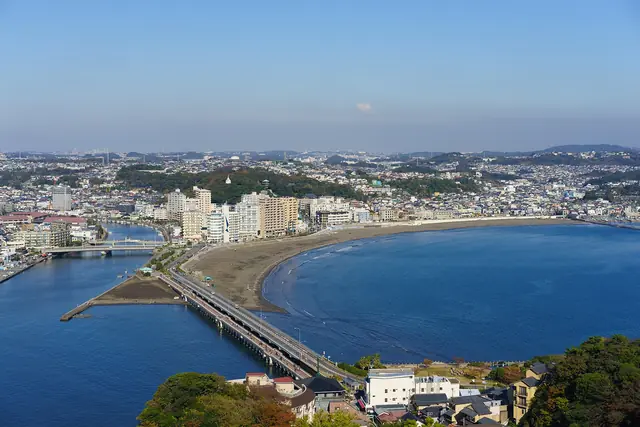
The Katase beaches lie on either side of the bridge: Katase Higashihama to the east, one of the oldest bathing beaches in Japan, and the long Katase Nishihama to the west, running past the Enoshima Aquarium toward Kugenuma. The official swimming season, with beach huts, lifeguards and showers, has run from early July to late August or into September in recent years. Smoking is allowed only in marked areas, and outside the season the beaches belong to surfers and walkers.
Weekends, Golden Week and summer are the busy times. Benzaiten Nakamise jams from late morning, by mid-afternoon there are queues for the Enoden at Enoshima, and on the biggest holidays entry is sometimes restricted at the Enoden's Kamakura Station. Arrive early, walk the island first and have lunch late. Watch your food outdoors: the kites circling over the beach snatch snacks straight from people's hands.
Two stops toward Kamakura, the level crossing by Kamakura-Kokomae Station appears in the opening of the anime Slam Dunk and draws big crowds. Kamakura's manners ordinance counts stopping in the road to take photos and leaning out over the tracks as nuisances, and in recent years the city has posted guards there and set up a small fenced photo area beside the crossing. Use it, keep the pavement clear and remember that students and residents cross here every day.
- Try shirasu, tiny whitebait. Raw shirasu is served only on days the boats go out, and not at all from January 1 to March 10.
- Weekday mornings are the quietest time for both the island and the crossing.
With Kamakura: a one-day plan
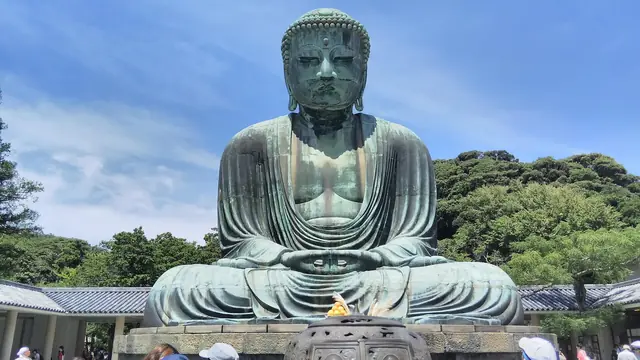
The Enoden runs from Enoshima to Kamakura in about 25 minutes, with Hase, the stop for the Great Buddha and Hasedera, a few stations before the end. The little train squeezes past houses, and between Koshigoe and Enoshima it runs down the middle of a street, so the two places make an easy single day.
For a morning start, take the Odakyu to Katase-Enoshima, walk the island out to the caves, ride the Enoden to Hase and Kamakura, and go home on JR from Kamakura Station. If you want the sunset on Enoshima, turn it around: Kamakura in the morning, the Enoden to Enoshima after lunch, the Sea Candle at dusk and the Odakyu straight back to Shinjuku. With children, the Enoshima Aquarium by Nishihama beach is a good plan for a rainy morning.