The temple and the cat
Gotokuji began in 1480 as Kotokuin, a small temple built by the Kira family, lords of Setagaya Castle. In 1633 Setagaya became part of the Hikone domain, and its lords, the Ii family, made the temple their family temple in Edo. It took the name Gotokuji in 1659, after the Buddhist name of the second lord, Ii Naotaka. It belongs to the Soto school of Zen.
The temple tells the cat story like this. Naotaka was on his way back from falconry when a cat at the temple gate beckoned to him, so he stopped in. Soon a sudden thunderstorm broke, and he sat out the rain talking with the priest. Grateful for his luck, he supported the rebuilding of the temple. Gotokuji enshrines that cat as a bringer of good fortune and writes its name with characters meaning "the cat that invites happiness", read maneki-neko. Other places in Tokyo, such as Imado Shrine in Asakusa, also claim the beckoning cat, and the details of the story vary between tellings.
What to see
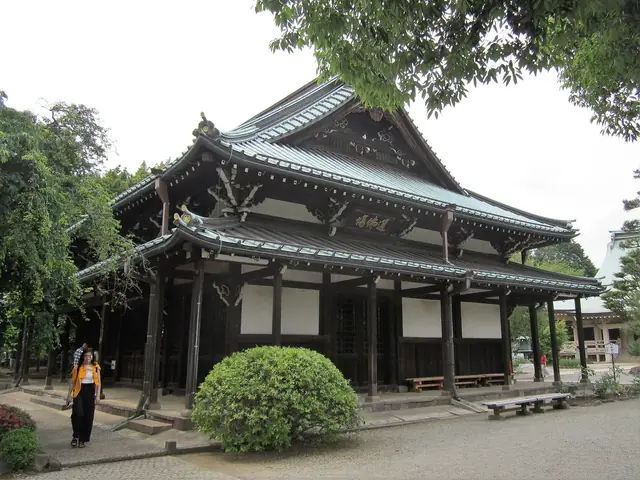
You walk in along a pine-lined approach to the Sanmon gate. Inside, the Buddha hall dates from 1677, and the temple bell, cast in 1679, is the oldest in Setagaya; both are ward cultural properties. The three-storey pagoda is new, completed in 2006 and 22.5 metres tall. Look at the carvings under its eaves: among the zodiac animals there is a beckoning cat.
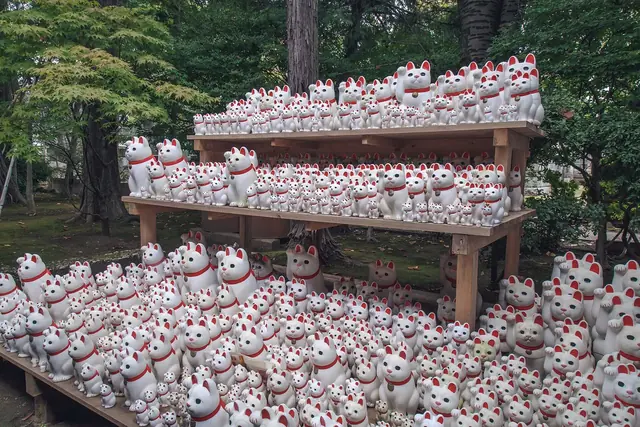
The Shofukuden, the cat hall, was built in 1941 and renovated in 2022. Beside it is the offering area, where cat figures of every size stand in rows, all with the right paw raised. Unlike the shop version, the temple's cats hold no gold coin: the temple says the cat brings you a connection, and what you make of it is up to you.
Behind the main buildings is the Ii family cemetery, a national historic site since 2008, where Ii Naosuke and other lords of Hikone are buried. It is a working cemetery, so keep your voice down.
- Cat figures are sold at the temple office, which closes around 3pm, earlier than the grounds.
- There is no fixed rule for what to do with your cat. Many people take one home and bring it back to the shelves once their wish comes true.
- Do not write on the cats. The temple has asked this specifically, since the figures are sacred.
The year at Gotokuji
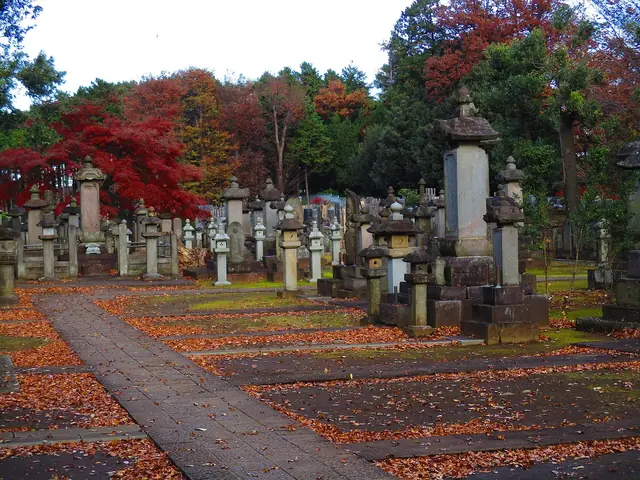
Gotokuji does not have a big festival calendar of its own; the year here is about plants. The temple lists plum, cherry, peony and azalea among its spring flowers, with autumn leaves late in the year, and in Tokyo the leaves usually turn from late November into early December. Spring and late autumn are the best times for photos of the pagoda. The temple also holds sutra copying sessions (shakyo) on set afternoons; check the official site for dates.
The neighbourhood has two bigger occasions. Setagaya Hachimangu, by Miyanosaka Station, holds its autumn festival in September with offering sumo by student wrestlers on the shrine's own ring, a custom that goes back to the Edo period. On December 15 and 16 and again on January 15 and 16, the Setagaya Boro-ichi, a street market that began in 1578, fills Boro-ichi Street around the old Daikan Yashiki a few stops away, with several hundred stalls of antiques, plants, tools and food.
- The Boro-ichi is very crowded around midday. Arrive soon after it opens in the morning.
Timing, crowds and manners
The grounds are open from 6am to 5pm and there is no entry fee. Gotokuji has become well known abroad, and late mornings and weekends can be busy around the cat shelves. Early morning on a weekday is the calmest time, and you may have the pagoda to yourself.
This is a working temple with a cemetery, set in a residential neighbourhood. Speak quietly, stay on the paths, and do not climb on or rearrange the offering shelves. The temple has said that it runs no official guided tours with any travel company, and that commercial guiding, photo shoots and events on the grounds need its permission in advance. For your own snapshots, just be quick and keep the paths clear.
- Bring cash for cat figures and charms.
- If you plan to hop on and off the Setagaya Line, a one-day ticket (Setagaya-sen Sanpo Kippu) pays off after a few rides.
Getting there and the Setagaya Line
The nearest station is Miyanosaka on the Tokyu Setagaya Line, about five minutes on foot. From Gotokuji Station on the Odakyu Line it is about fifteen minutes through quiet streets, and Yamashita Station on the Setagaya Line stands right by Odakyu Gotokuji Station if you want to change.
The Setagaya Line is a small two-car line that runs about 5 km between Sangenjaya and Shimotakaido, with a flat fare and short gaps between stations. It opened in 1925 as part of the old Tamaden tramway, and in some years it has run trains decorated with beckoning cats. It makes an easy half day: Setagaya Hachimangu right by Miyanosaka, the Boro-ichi street at Kamimachi and Setagaya stations, and Sangenjaya at one end, with the Setagaya Public Theatre and plenty of small bars. From Shibuya, take the Den-en-toshi Line to Sangenjaya and change; Shimokitazawa is a few stops away on the Odakyu Line.