Dates, time and the three launch sites
The Kawaguchiko Winter Fireworks (Kawaguchiko Fuyu Hanabi) are run by a committee of the town of Fujikawaguchiko. In recent years they have been held on Saturdays and Sundays from the second half of January to late February, plus February 23 (Mt Fuji Day, which is also the Emperor's Birthday holiday), whatever day of the week it falls on. That makes about ten or eleven evenings a season. The dates for the coming winter are announced by the town and on the Yamanashi tourism site, usually a few weeks before the first show.
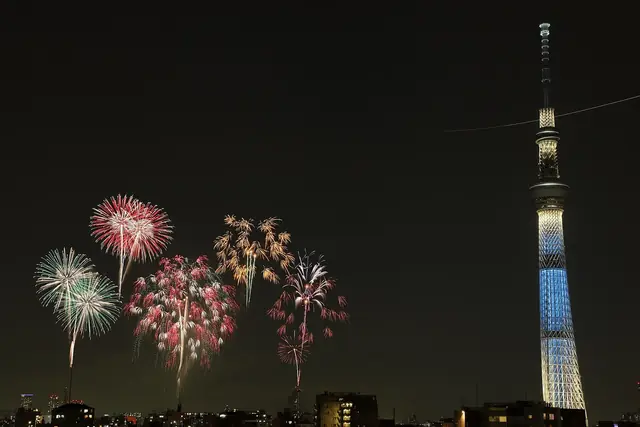
Each show starts at 8pm and lasts about twenty minutes. The fireworks go up from three places at once: Oike Park, the main venue at the southern end of Kawaguchiko Bridge, Tatamiiwa, a rock at the water's edge by the Funatsuhama car park, and Yagisaki Park on the southern shore. Watching is free and there are no seats to book. Food trucks set up at Oike Park from about 3pm on fireworks days, so you can get something hot before the start.
Light rain or snow does not usually stop the show, but strong wind can. The 2026 announcement also warned that the display may be cancelled while a forest fire warning is in force, which matters in the dry winter months. Check the town's announcements on the day before you set out.
- Twenty minutes passes quickly. Have your camera ready before 8pm rather than after the first shell.
- On Saturdays the lakeside in front of Oike Park fills from about 7pm. Arrive by 7:30pm at the latest.
Where to watch, and seeing Fuji at night
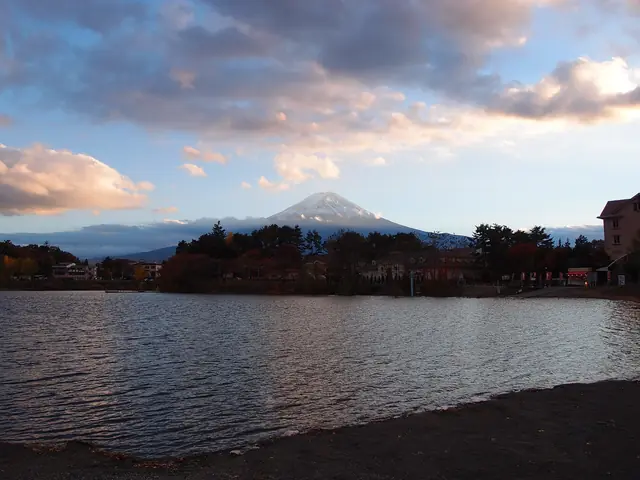
Oike Park is the easiest place: the shells burst almost overhead, the food trucks are there and it is about 20 minutes on foot from Kawaguchiko Station. Stand on the lakeside path in front of the park, where the view over the water is open. Across the bridge, the small cape of Ubuyagasaki on the north-eastern shore lets you see all three launch sites at once, which is why photographers like it. The lakeside promenade at Funatsu, between the station and Tatamiiwa, is a good middle ground if you are staying in that area.
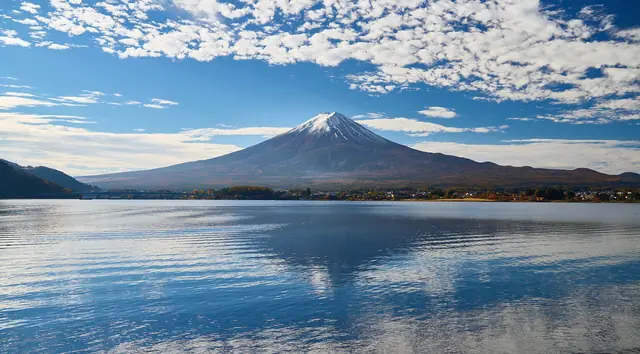
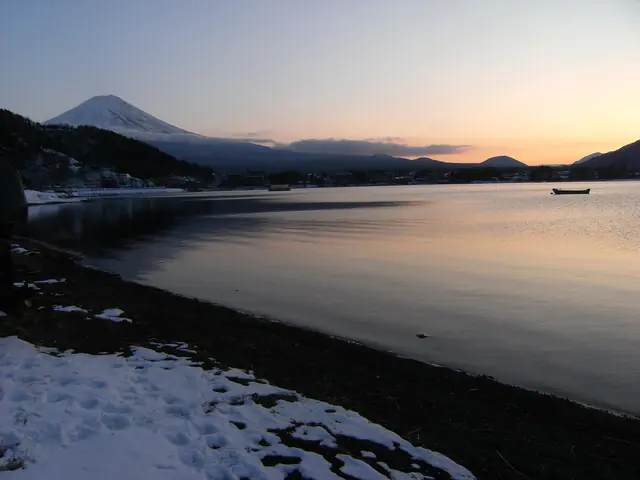
Be realistic about Fuji. At 8pm the mountain is dark, and on clear, moonlit nights it shows only as a pale outline of snow. Most of the famous photos of fireworks with Fuji are long exposures. The good news is that winter is the season when Fuji is most often clear in the daytime. Come in the afternoon, watch the sunset turn the snow pink from the northern shore, eat at the food trucks and then watch the show. Some lakeside inns at Funatsu and Asakawa face the launch sites, and their guests watch from a warm room.
- Bring a tripod for photos and keep it off the footpath. A remote shutter or the phone's timer stops the shake.
- Kawaguchiko Bridge carries traffic and has nowhere to stop. Watch from the shore.
Dressing for a winter night at 830 m
The lake lies about 830 m above sea level, and on a clear February night the temperature at the shore often drops several degrees below zero, around ten degrees colder than central Tokyo. You stand still for at least half an hour, often longer, and the wind off the water makes it feel colder still.
Dress as you would for a ski slope rather than a city evening: thermal underwear, a fleece or sweater, a down jacket, a hat that covers your ears, gloves, warm socks and boots with a good grip, since paths and car parks can be icy. Disposable hand warmers (kairo) from any convenience store help, and a small mat or a piece of cardboard to stand on keeps the cold of the ground away from your feet. A flask of something hot is worth carrying, as the queues at the food trucks get long just before 8pm.
If you drive, the roads around the lake and the Chuo Expressway can have snow and ice in January and February. Winter tyres or chains are a must, and after snowfall the lakeside roads are slow.
- Check the forecast for Fujikawaguchiko, not Tokyo. A sunny day in the city can mean snow at the lake.
Getting there from Tokyo and back after the show
Highway buses from Busta Shinjuku reach Kawaguchiko Station in about 1 hour 45 minutes to 2 hours, and since October 2026 the route runs 55 buses a day each way. Keio and Fujikyu share the line but now sell seats on separate sites (Keio on Highway Bus.com, Fujikyu on FUJIYAMA CONNECT), so switching from one company's bus to the other's means cancelling and booking again.
By train, take the JR Chuo Line from Shinjuku to Otsuki and change to the Fujikyu line, or ride the Fuji Excursion limited express straight from Shinjuku in about two hours with a reserved seat. The catch on fireworks night: in the timetable from March 2026, the last Fuji Excursion back leaves Kawaguchiko in the late afternoon. After the show you are on Fujikyu local trains to Otsuki, which run until about 10pm, but only those leaving Kawaguchiko a little after 9pm still connect to central Tokyo the same night. Check the connection in a route planner before you go.
From the station to Oike Park, walk about 20 minutes along the lake or take the Kawaguchiko sightseeing bus (Red Line) to the Kawaguchiko Herb Hall stop. Coming back, check the time of the last bus; most people simply walk. If you drive, Oike Park has a free car park, but on Saturdays it fills well before 8pm and the roads out are slow afterwards.
- To get back to Tokyo the same night, check the train connection at Otsuki before you go. A highway bus only works if one leaves Kawaguchiko after about 8:45pm on your date. Otherwise plan to stay.
- The Japan Rail Pass covers JR only as far as Otsuki. The Fujikyu line is paid separately.
Staying the night by the lake
Staying over turns a cold dash into an easy trip, and it gives you the morning, when Fuji is most likely to be clear. Funatsu, the area around Kawaguchiko Station and the eastern shore, puts you within walking distance of Oike Park and has the most hotels and inns. Across the bridge, the Asakawa hot spring area on the north-eastern shore faces Fuji over the water; inns there, such as Ubuya by Ubuyagasaki, offer rooms that look straight at the mountain. The quieter northern shore around Oishi has small pensions and lodges, handy if you have a car.
On a tighter budget, the business hotels around Fujisan Station in Fujiyoshida, a few minutes back along the Fujikyu line, are usually cheaper than the lakeside. Saturday nights in the fireworks weeks book up first, and so do the evenings around February 23. A Sunday night is often easier to find, and the Sunday show is the same.
- Ask for a lake-facing room when you book. Some rooms look at the launch sites, others at the car park.
Other winter things around the lakes
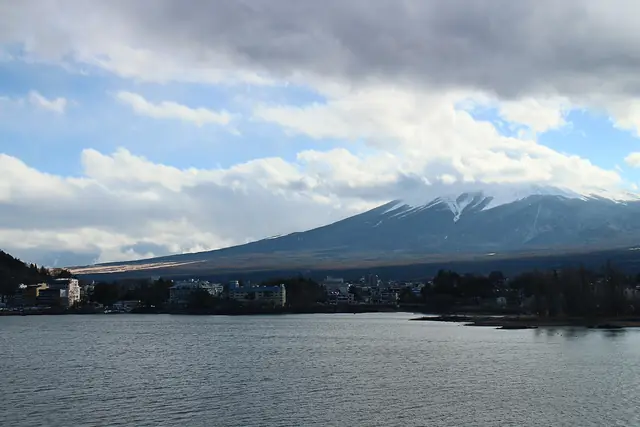
Lake Sai, the next lake to the west, holds the Saiko Ice Festival (Saiko Kori Matsuri, formerly the Saiko Tree Ice Festival) at Saiko Wild Bird Forest Park from late January into the first half of February. Pillars and walls of ice several metres tall are lit from dusk until 7pm, with Fuji behind them on clear days. Entry is free, and there are food stalls on weekends and holidays. Buses from Kawaguchiko Station take about 40 minutes, so the two fit one Saturday: ice in the late afternoon, fireworks at 8pm.
Hot springs are the other winter pleasure. Most inns around the lake have onsen baths, and on a day trip, Fuji Chobo no Yu Yurari in Narusawa has outdoor baths facing Fuji and stays open until 9pm on weekdays and 10pm at weekends and on holidays, with last entry an hour earlier. In the daytime the Mt Fuji Panoramic Ropeway climbs above the lake, and the dry winter air gives the sharpest views of the year.
- Yurari is not near the station. Go by bus or taxi and check how you will get back.