
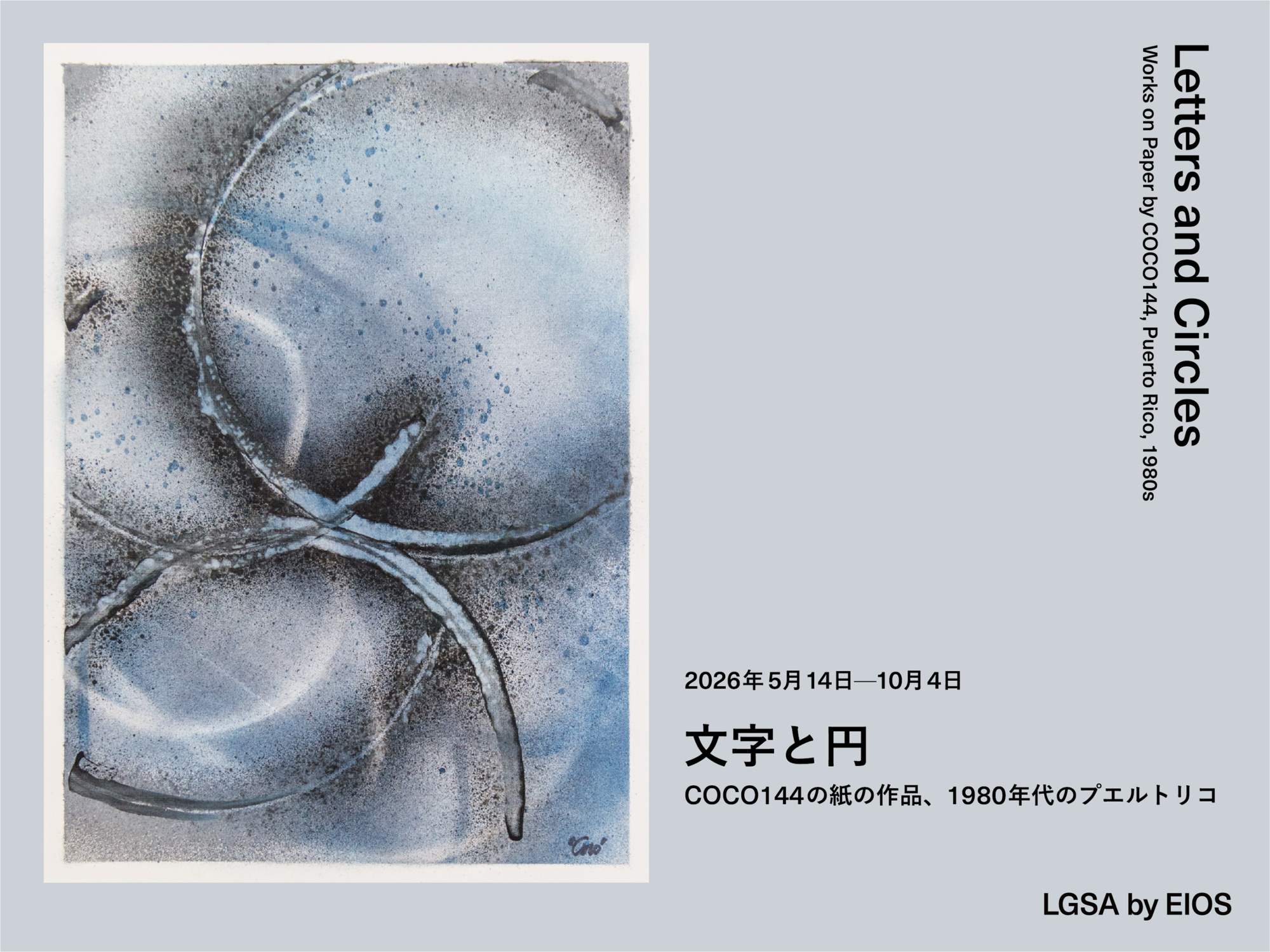
Coco144 "Letters and Circles -Works on Paper by Coco144, Puerto Rico, 1980s"
May 14 – October 4, 2026
Free entry
LGSA by EIOS is pleased to present Letters and Circles: Works on Paper by COCO144, Puerto Rico, 1980s, a solo exhibition of works by COCO144 (Roberto Gualtieri), marking his first presentation in Japan.
Born in New York, of Puerto Rican and Italian heritage, COCO144 is widely recognized as a foundational figure in the emergence of aerosol writing during the late 1960s and early 1970s. Writing his name across the city’s subway system at a time of social tension and limited visibility, he participated in the transformation of tagging into a structured visual idiom, developing a practice shaped by both urgency and control under conditions where each mark carried risk and intention.
Within this context, COCO144 introduced several key technical and conceptual innovations that expanded the possibilities of writing. His early use of stencils enabled clarity and efficiency in environments where time and space were constrained, and at a moment when most writers relied on freehand aerosol gesture, this approach established a distinct visual discipline that functioned as both an aesthetic strategy and a tactical response.
Alongside this, COCO144 explored formal elements that would later become central to the language of writing culture. Motifs such as stars and crowns articulated emerging notions of authorship, recognition, and style, while his engagement with the expressive potential of the drip transformed what was often perceived as a technical flaw into a deliberate painterly strategy, contributing to the formation of a new and flexible visual grammar.
In 1972, he became a founding member of United Graffiti Artists (UGA), the first collective of street writers to bring aerosol writing into gallery contexts. Through exhibitions in New York and beyond, UGA did not simply legitimize writing retrospectively, but instead confronted existing art systems with a new visual language as it was still unfolding, establishing a precedent for later exchanges between street practices and institutions.
During the mid-1970s, COCO144 also contributed to early efforts to document the culture as it developed. When the Italian researcher Andrea Nelli visited New York to study aerosol writing, COCO144 guided him through the city and its emerging writing scene, an exchange that later resulted in Graffiti a New York (1978), now regarded as one of the first sustained studies of the movement and an important step in its historical recognition.
This exhibition Letters and Circles focuses on a body of works on paper developed during and after his time in Puerto Rico in the 1980s. In these works, such as LUNA AZUL, his practice shifted toward a more sustained engagement with form while remaining grounded in the logic of writing. As the letters C and O are repeated, his name gradually transforms into a structure that moves between legibility and abstraction over time.
As these forms expand across the surface, the structure of the name begins to dissolve into sequences of curves and circular movements, while color operates both within and beyond the line, separating and reassembling to create a dynamic spatial field in which authorship is not abandoned but extended, allowing the name to function as a generative system rather than a fixed sign across different contexts.
Across more than five decades, COCO144 has continued to revisit and develop this language, demonstrating how a form shaped under specific historical conditions can evolve without losing coherence, and where repetition is not simply reiteration but an ongoing investigation into structure, variation, and continuity, in which each iteration carries both memory and transformation across time, extending the work’s logic while remaining open to new formal possibilities.
This exhibition introduces COCO144’s practice to audiences in Japan by situating his work within both its historical significance and its ongoing development, offering an opportunity to engage with a body of work that continues to move between origin and transformation while also reflecting a commitment to framing this history within a specific cultural context through careful attention, dialogue, and critical engagement.


Comments 0
Sign in to leave a comment.