
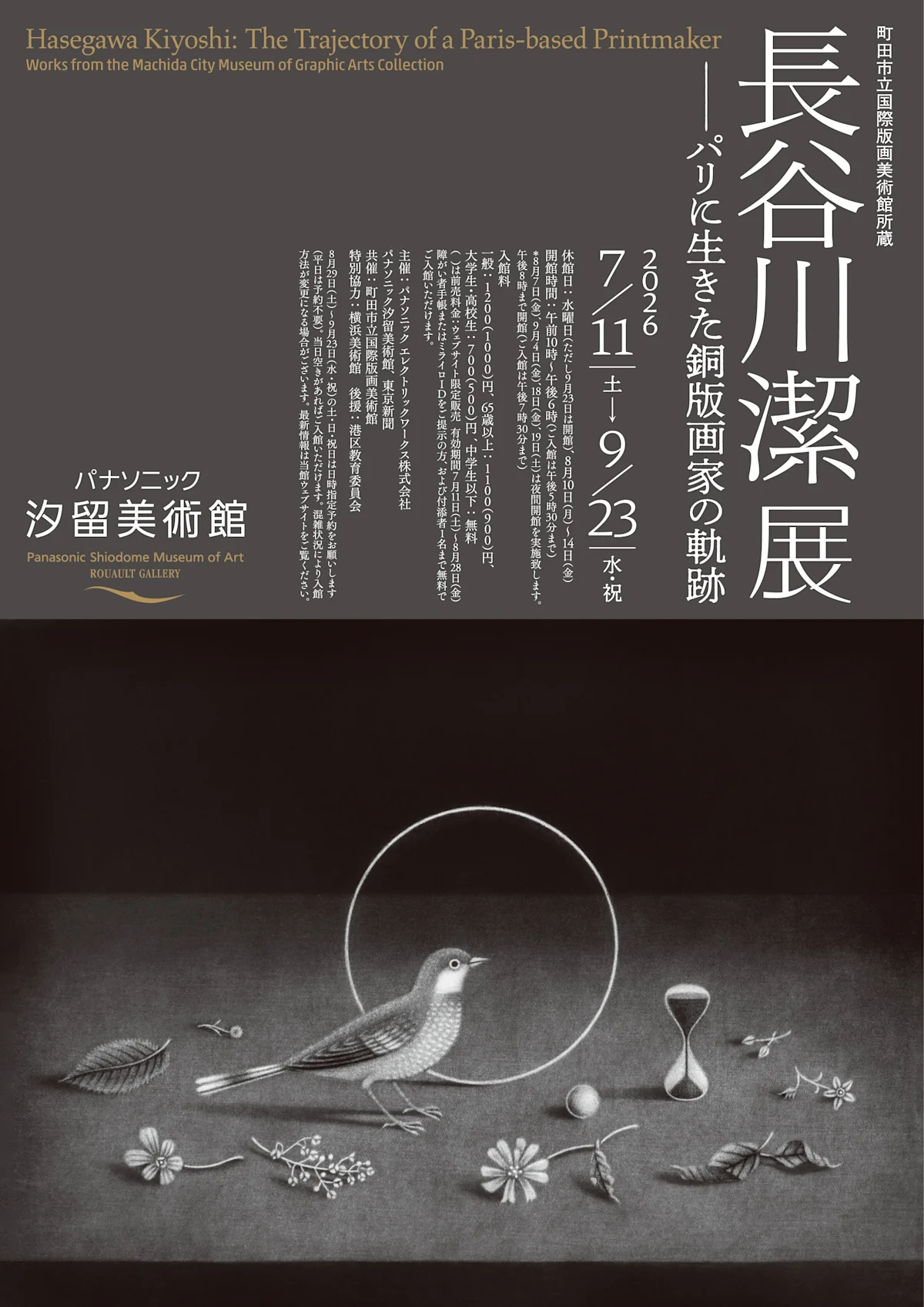
Hasegawa Kiyoshi: The Trajectory of a Paris-based Printmaker
Saturday, July 11, 2026
Panasonic Shiodome Museum of Art
4F Panasonic Tokyo Shiodome Bldg., 1-5-1 Higashi-Shimbashi, Minato-ku, Tokyo 105-8301
⌖ Open in Maps ↗After the First World War, Hasegawa Kiyoshi (1891–1980), one of Japan’s preeminent print artists, moved to France, where he remained for the rest of his life. In his own unique way, Hasegawa made a huge impact on the history of printmaking by reviving the traditional copper printing technique of manière noire (mezzotint), which was then on the verge of dying out. He also explored various other techniques such as engraving and aquatint, creating a body of profound and spiritual monochrome expression that continues to attract people even today.
Although Hasegawa exerted a strong influence on Japanese printmaking, his practice was rooted in Paris. In the 1920s, as he coming into his own as an artist, Hasegawa discovered the work of the painter and printmaker Raoul Dufy, and joined in the Société des Peintres-Graveurs Indépendants, which included artists such as Henri Matisse, Pablo Picasso, and Marc Chagall. Hasegawa also went to great lengths to introduce French audiences to Japanese traditional prints, and created engravings for an edition of the literary classic Taketori monogatari (The Tale of the Bamboo Cutter). In addition to pre-19th century prints that influenced the artist and works by his contemporaries in Paris, this exhibition presents a host of Hasegawa’s career-spanning masterworks drawn primary from the Machida City Museum of Graphic Arts, home to one of Japan’s leading collections of Hasegawa Kiyoshi’s art.

Comments 0
Sign in to leave a comment.